

What Is 6 AWG Wire?
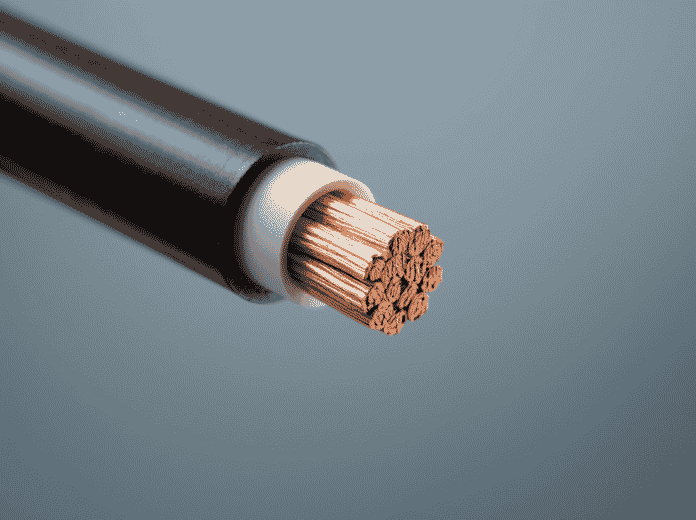
6 AWG wire is a medium-gauge electrical conductor with a diameter of 4.11 mm (0.162 inches) and a cross-sectional area of 13.3 mm². In the American Wire Gauge (AWG) system, smaller numbers mean thicker wire — so 6 AWG carries significantly more current than 8 AWG or 10 AWG.
The actual outside diameter varies by insulation type. A bare solid copper 6 AWG conductor measures exactly 4.11 mm, but the same wire with THHN insulation might have an OD closer to 6.5 mm. Stranded versions run slightly thicker than solid due to air gaps between strands.
Wire material also affects dimensions. Aluminum 6 AWG conductors are physically larger than copper equivalents because aluminum has higher electrical resistance and needs more cross-sectional area to carry the same current. Copper-clad aluminum (CCA) sits in the middle — aluminum core, copper outer layer, lighter than pure copper but more conductive than pure aluminum.
6 AWG Wire Ampacity — How Many Amps Can It Handle?
Ampacity isn’t a single number. It depends on three variables: conductor material, insulation temperature rating, and installation environment.
Copper 6 AWG Ampacity (NEC 2020)
| Temperature Rating | Insulation Types | Ampacity |
| 60°C (140°F) | TW, UF | 55 Amps |
| 75°C (167°F) | RHW, THHW, THWN | 65 Amps |
| 90°C (194°F) | THHN, XHHW, THWN-2 | 75 Amps |
Aluminum 6 AWG Ampacity (NEC 2020)
| Temperature Rating | Insulation Types | Ampacity |
| 60°C (140°F) | TW, UF | 40 Amps |
| 75°C (167°F) | RHW, THHW, THWN | 50 Amps |
| 90°C (194°F) | THHN, XHHW | 55 Amps |
The 80% Rule (NEC 210.19)
The NEC requires continuous loads (running 3+ hours) to use no more than 80% of a circuit’s rated capacity. For a 6 AWG copper wire at 75°C:
- Rated ampacity: 65A
- Safe continuous load: 65 × 0.8 = 52 Amps
This is the number that matters in practice. A 6 AWG copper circuit on a 60A breaker is standard for residential installations.
Critical Note on Termination Ratings
Even if you’re using 90°C-rated THHN wire, most circuit breakers and terminals are rated for 60°C or 75°C. The weakest link rules. In practice, you should size 6 AWG copper at the 60°C or 75°C column — not 90°C — unless every component in the circuit carries a 90°C rating.
Free Air vs. Conduit
Wire in free air dissipates heat better than wire packed in conduit. 6 AWG copper in free air at 90°C can handle up to 105 amps. But once you run it through conduit — especially with other current-carrying conductors — derating applies. Bundle 4-6 current-carrying conductors together and you’ll need to derate to 80% of the table value.
Ampacity Over Distance
Voltage drop becomes the limiting factor on long runs. As a rule of thumb, ampacity drops roughly 10% for every 50 feet beyond the first 50 feet:
| Wire Length | Copper 6 AWG (75°C, 80% Rule) |
| 50 ft | 52 Amps |
| 100 ft | 43 Amps |
| 150 ft | 40 Amps |
| 200 ft | 37 Amps |
For runs over 150 feet carrying near-maximum current, consider upsizing to 4 AWG.
6 AWG Wire Wattage Capacity
Wattage depends on voltage. The formula is straightforward:
Watts = Amps × Volts
Using the 80% rule at 75°C (52A for copper, 40A for aluminum):
| Voltage | Copper 6 AWG Max Wattage | Aluminum 6 AWG Max Wattage |
| 12V | 624W | 480W |
| 24V | 1,248W | 960W |
| 120V | 6,240W | 4,800W |
| 240V | 12,480W | 9,600W |
On a standard 240V residential circuit, 6 AWG copper delivers up to 12.48 kW — enough for an electric range, large air conditioner, or subpanel feeding a detached garage.
6 AWG vs 8 AWG Wire — Key Differences
| Specification | 6 AWG | 8 AWG |
| Diameter | 4.11 mm (0.162 in) | 3.26 mm (0.128 in) |
| Cross-section | 13.3 mm² | 8.37 mm² |
| Copper ampacity (75°C) | 65A | 50A |
| Safe continuous load (80%) | 52A | 40A |
| Typical breaker size | 50A or 60A | 40A |
| Weight per 100 ft (copper) | ~12.5 lbs | ~7.9 lbs |
The jump from 8 AWG to 6 AWG gives you roughly 30% more current capacity. If your 8 AWG circuit keeps tripping a 40A breaker, 6 AWG on a 50A or 60A breaker is the logical upgrade.
Common Types of 6 AWG Wire & Cable
THHN / THWN-2
The workhorse of commercial and residential wiring. THHN is rated for dry locations up to 90°C; THWN-2 adds wet-location rating. Used in conduit for feeders, branch circuits, and connections to HVAC equipment. If you’re pulling wire through EMT conduit in a commercial building, this is what you’re using.
XHHW
XLPE-insulated, rated for 90°C in both wet and dry conditions. Better heat resistance than THHN, commonly specified for industrial environments and outdoor conduit runs.
NM-B (Romex)
The standard for residential interior wiring. 6 AWG NM-B typically comes as 6/2 or 6/3 (two or three conductors plus ground). Used for electric ranges, ovens, and large air conditioners. Not rated for outdoor or direct burial use.
UF-B
Underground Feeder cable — direct burial without conduit. 6 AWG UF-B powers detached garages, well pumps, landscape lighting circuits, and outbuildings. The solid thermoplastic jacket resists moisture and soil acidity.
SER (Service Entrance)
Connects the utility meter to the main panel. 6 AWG SER is common in smaller homes and mobile homes where the service load stays under 60 amps.
Welding Cable
Highly flexible, with fine-stranded copper conductors and EPDM rubber insulation. Rated for 600V. The flexibility comes from using dozens of thin strands instead of a few thick ones — essential for welders who coil and uncoil cable constantly.
Battery Cable
Used in automotive, marine, and solar battery banks. 6 AWG battery cable handles starter motor inrush currents in compact cars, golf carts, and small boats. Typically SAE J1127 rated, with PVC or cross-linked insulation resistant to oil, grease, and battery acid.
For residential or cabin off-grid systems, this gauge is also ideal for wiring battery banks to charge controllers and inverter setups.
Welding Cable vs. Battery Cable
Both carry the same current at the same gauge. The difference is construction. Welding cable uses finer stranding for flexibility at higher voltages (600V). Battery cable uses slightly thicker strands and is optimized for 12V-24V systems where the cable stays in place. For tight routing in an engine bay, welding cable’s flexibility wins. For a straightforward battery-to-starter run, standard battery cable works fine and costs less.
Typical Applications of 6 AWG Wire
Residential
- Electric ranges and wall ovens (typically 40A-50A circuits)
- Central air conditioning condensers (up to 5-ton units)
- Subpanels in garages, workshops, or additions (50A-60A feed)
- Hot tubs and spas (50A GFCI circuits)
- Tankless electric water heaters
- EV charger installations (Level 2, 40A-48A continuous)
- expandable container house
Commercial & Industrial
- Feeder circuits to distribution panels
- Motor connections for air compressors, pumps, and HVAC equipment
- Temporary power distribution on construction sites
- Machine tool power supplies
- High pressure reactors
Automotive & Marine
- Battery-to-starter connections in compact vehicles
- Winch power cables (check winch amp draw — some require 4 AWG or larger)
- Auxiliary battery banks in RVs and boats
- High-output alternator wiring
For marine wiring harness applications, tinned copper 6 AWG is strongly recommended — the tin coating prevents corrosion in saltwater environments. OUKETECH provides custom marine wiring harness solutions with tinned conductors and sealed connectors for harsh marine conditions.
Renewable Energy
- Solar array-to-charge controller wiring
- Battery bank interconnects (48V systems)
- Wind turbine-to-inverter runs
- Grounding conductors for solar installations
Industrial Equipment
In manufacturing environments, 6 AWG feeds motor control panels, pumping systems, and air compressors. In these industrial pumping, HVAC, and process systems, electrical reliability is only one part of overall system performance. Efficient thermal management is equally important, and industrial plate heat exchangers are commonly used for cooling, heating, and heat recovery duties.When integrated into an industrial wire harness, 6 AWG conductors are often bundled with signal wires and protective jacketing to create a single plug-and-play assembly. This approach simplifies installation and improves reliability compared to running individual wires through conduit.
6 AWG Wire Selection Guide
Step 1: Determine Your Load
Calculate the maximum continuous current your circuit will draw. Multiply by 1.25 for the NEC continuous load requirement. If your load is 48A, you need a circuit rated for at least 60A — which means 6 AWG copper at 75°C.
Step 2: Measure the Distance
For runs over 100 feet, calculate voltage drop. Aim for less than 3% voltage drop on branch circuits. If the drop exceeds 3%, go up one gauge size.
Step 3: Choose Copper or Aluminum
- Copper: Higher ampacity, smaller diameter, better corrosion resistance, more expensive
- Aluminum: Lighter, cheaper, but needs anti-oxidant compound at connections and larger gauge for equivalent ampacity
For most residential projects, copper is the default. Aluminum sees more use in service entrance and utility applications where cost and weight matter more than space.
Step 4: Match Insulation to Environment
- Indoor, dry, in conduit: THHN
- Wet locations, conduit: THWN-2 or XHHW
- Direct burial: UF-B
- High-temperature areas: XHHW or armored cables with appropriate temperature ratings
- Underground service entrance: USE-2
Step 5: Solid vs. Stranded
- Solid: Cheaper, stiffer, better for permanent installations where the wire won’t move. Common in NM-B.
Stranded: More flexible, easier to pull through conduit, better for applications with vibration or movement. Standard for THHN in conduit and all custom cable assemblies
Frequently Asked Questions
Can 6 AWG wire handle 60 amps?
Yes — with conditions. 6 AWG copper with 75°C insulation (THHN, THWN) is rated for 65 amps. After applying the NEC 80% rule, the safe continuous load is 52 amps. For a 60-amp circuit, you can use 6 AWG copper if the load is non-continuous (under 3 hours). For continuous 60-amp loads, step up to 4 AWG.
What breaker size for 6 AWG wire?
50-amp or 60-amp breaker, depending on the load. A 50-amp breaker is the conservative choice and aligns with the 80% rule. A 60-amp breaker is acceptable for non-continuous loads. Never exceed 60 amps on 6 AWG copper.
Is 6 AWG good for 50 amps?
Yes. 6 AWG copper handles 50 amps comfortably at any temperature rating. It’s the standard choice for 50-amp circuits — hot tubs, RV hookups, and subpanels all commonly use 6 AWG on 50A breakers.
How far can you run 6 AWG wire?
For a 50-amp load at 240V, you can run approximately 150 feet before voltage drop exceeds 3%. For a 30-amp load at 120V, the maximum distance is roughly 100 feet. Use a voltage drop calculator for your specific voltage, current, and acceptable drop percentage.
Can I use 6 AWG for a 48-amp EV charger?
Yes. A 48-amp EV charger is a continuous load. Per NEC, the circuit must be sized at 125% of the continuous load: 48A × 1.25 = 60A. 6 AWG copper THHN in conduit on a 60A breaker meets this requirement. If using NM-B (Romex), which is limited to the 60°C column (55A), you’d need to size up to 4 AWG — this is a common point of confusion for DIY EV charger installs.
Conclusion
6 AWG wire occupies a practical middle ground — heavy enough for serious residential circuits and light industrial applications, but still manageable to pull and terminate. For most 50-60 amp circuits under 150 feet, it’s the right choice.
Whether you’re wiring a subpanel, installing an EV charger, or building a custom wire harness for industrial equipment, getting the gauge right is step one. The rest comes down to matching insulation type to environment, respecting the 80% rule, and accounting for voltage drop on long runs.
As a custom wire harness manufacturer, OUKETECH works with 6 AWG conductors daily — from automotive wire harness assemblies to complex industrial wire harness builds. If your project requires custom cable assemblies with specific gauge, insulation, and connector requirements, contact OUKETECH for engineering support.