

Table of Contents
Related OUKETECH resources: custom telecom cable assemblies.
- What Is RG-6 Cable?
- What Does “RG” Actually Mean?
- RG-6 Technical Specifications
- Types of RG-6 Cable: Not All RG-6 Is the Same
- RG-6 vs RG-59 vs RG-11: How They Compare
- Where RG-6 Cable Gets Used
- How Far Can RG-6 Run? Distance and Signal Loss
- How to Spot Quality RG-6 Cable
- RG-6 Connectors and Installation Basics
- RG-6 vs Cat6: Two Different “6 Series” Cables
- Frequently Asked Questions
- The Bottom Line
What Is RG-6 Cable?
RG-6 is a 75-ohm coaxial cable. It carries radio frequency (RF) signals — TV, satellite, internet, security camera feeds — from point A to point B with minimal loss.
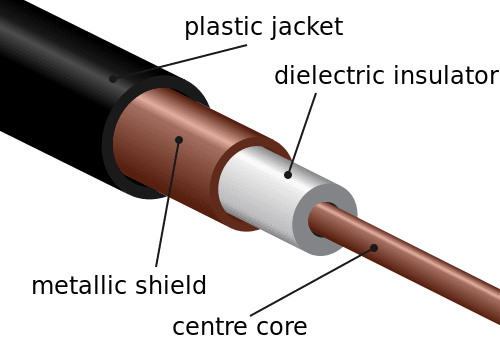
Inside every RG-6 cable, you’ll find four layers:
- Center conductor — 18 AWG, either solid copper or copper-clad steel (CCS)
- Dielectric insulator — polyethylene foam that keeps the center conductor spaced precisely from the shield
- Metallic shielding — at least one foil layer plus a braided layer; quad-shield versions add more
- Outer jacket — PVC or PE, protecting everything inside
The name “coaxial” comes from the geometry: the center conductor and the outer shield share the same axis. This isn’t just a naming quirk — it’s what lets coax carry high-frequency signals over long distances without turning into an antenna.
RG-6 is the most common coax cable in homes today. If you’ve got cable TV or a satellite dish, there’s almost certainly RG-6 in your walls.
What Does “RG” Actually Mean?
RG stands for “Radio Guide.” The term goes back to World War II, when the U.S. military needed a standardized way to specify radio frequency cables. Each RG number — RG-6, RG-8, RG-11, RG-58, RG-59 — mapped to a specific set of electrical and physical characteristics in the original military specification.
That military spec is long obsolete. Nobody builds cables to the original Radio Guide standard anymore. Today’s cables are technically “RG-6 type” — they follow the general blueprint but use modern materials and manufacturing.
The numbers themselves don’t carry technical meaning anymore. They’re just labels that stuck. But the industry still uses them because everyone knows what an RG-6 is. It’s a 75-ohm coax with an 18 AWG center conductor. That part hasn’t changed.
The “U” you sometimes see — as in RG-6/U — originally meant “universal” or “general utility.” These days it’s mostly marketing.
RG-6 Technical Specifications
Here are the numbers that define RG-6 cable:
| Parameter | Specification |
|---|---|
| Impedance | 75 Ω |
| Center conductor | 18 AWG |
| Outer diameter | ~0.332 inches (8.4 mm) |
| Capacitance | ~20 pF/ft (65 pF/m) |
| Typical frequency range | 2 MHz – 3,000 MHz |
| Velocity of propagation | 78% – 85% (varies by dielectric) |
Signal Attenuation by Frequency
Attenuation — signal loss over distance — is the number that matters most in real installations. Here’s what to expect from a typical RG-6 cable:
| Frequency | Attenuation (per 100 ft / 30 m) |
|---|---|
| 50 MHz | ~1.5 dB |
| 100 MHz | ~2.0 dB |
| 400 MHz | ~4.3 dB |
| 700 MHz | ~5.8 dB |
| 1,000 MHz (1 GHz) | ~6.8 dB |
| 2,150 MHz | ~10.3 dB |
| 3,000 MHz | ~12.5 dB |
The pattern is straightforward: higher frequencies lose more signal per foot. For satellite TV installations operating around 2 GHz, you’ll lose roughly 10 dB per 100 feet. That’s why satellite installers pay close attention to cable quality and run length.
Sweep testing matters. A cable that’s sweep-tested to 3,000 MHz has been verified to perform consistently across its entire rated frequency range. Cheap cables that skip this testing can have dead spots — frequencies where attenuation spikes unexpectedly. For satellite and HDTV use, always choose sweep-tested cable.
Types of RG-6 Cable: Not All RG-6 Is the Same
Walk into any supplier and you’ll see RG-6 isn’t one product. Here’s how they differ.
By Shielding
| Shielding Type | Layers | Best For |
|---|---|---|
| Dual shield | 1 foil + 1 braid (60% coverage) | Indoor CATV, short runs |
| Tri-shield | 1 foil + 1 braid + 1 foil | Moderate interference environments |
| Quad shield | 2 foil + 2 braid (60% + 40% coverage) | High-interference areas, outdoor, satellite |
Quad-shield RG-6 has two layers of foil alternating with two layers of braid. It’s overkill for most indoor setups but makes a real difference when you’re running cable near power lines, fluorescent lights, or in commercial buildings with heavy RF noise.
By Center Conductor
- Solid copper (BC) — Lower DC resistance. Carries voltage for powered devices like satellite LNBs and amplified antennas. Costs more. Required for any installation where the cable also delivers power.
- Copper-clad steel (CCS) — Steel core with copper coating. Cheaper, stronger, but higher resistance. Fine for passive signal-only runs. Don’t use it for powered applications — the voltage drop over distance becomes a problem.
Here’s a rule of thumb I give customers: if your antenna, dish, or camera needs power over the coax, use solid copper. If it’s just carrying signal from a wall outlet to a TV, CCS works fine.
By Jacket Type
- PVC (standard) — For indoor use. Flexible, easy to strip, affordable.
- PE (polyethylene) — Better UV and moisture resistance. Used for outdoor runs.
- Plenum-rated (CMP) — Fire-rated jacket that doesn’t emit toxic smoke. Required by code in plenum air spaces (above drop ceilings, inside HVAC returns). Costs significantly more.
- Direct burial — Heavy-duty jacket with gel-filled or dry water-blocking. Designed to go underground without conduit. The gel filling prevents water migration if the jacket gets nicked.
RG-6 vs RG-59 vs RG-11: How They Compare
These three are all 75-ohm coax cables, but they’re not interchangeable.
| Feature | RG-59 | RG-6 | RG-11 |
|---|---|---|---|
| Center conductor | 20 AWG | 18 AWG | 14 AWG |
| Outer diameter | ~0.242 in (6.1 mm) | ~0.332 in (8.4 mm) | ~0.405 in (10.3 mm) |
| Attenuation @ 1 GHz | ~9.5 dB/100ft | ~6.8 dB/100ft | ~4.5 dB/100ft |
| Flexibility | Very flexible | Good | Stiff |
| Typical use | Short video runs, CCTV | CATV, satellite, internet | Long outdoor/underground runs |
| Connector compatibility | F-type, BNC, RCA | F-type, BNC, RCA | F-type only (too thick for RCA) |
RG-59 was the standard for TV antenna connections decades ago. It’s thinner, more flexible, and still used for short CCTV camera runs. But its higher attenuation makes it a poor choice for satellite or HDTV signals over any real distance.
RG-11 is the heavy-duty option. Thick center conductor, lowest signal loss per foot, but it’s stiff, hard to work with, and won’t fit standard RCA connectors. You’ll see it in long trunk lines — think cable company distribution, not home theater setups.
RG-6 sits in the sweet spot: thick enough for low loss, thin enough to route through walls and terminate with common connectors.
One more thing: RG-8 and RG-58 are 50-ohm cables used for radio transmission (CB, ham radio, old Ethernet). Don’t confuse them with 75-ohm video cables. They won’t work for TV or satellite.
Where RG-6 Cable Gets Used
Cable TV and Satellite
This is RG-6’s bread and butter. Cable companies use it from the street to the set-top box. Satellite installers rely on it from the dish LNB to the receiver. The 75-ohm impedance matches broadcast equipment, and the shielding keeps the signal clean.
Internet (Cable Broadband)
If your internet comes through the same coax as your TV, that’s RG-6. DOCSIS modems (the standard for cable internet) are designed around RG-6’s characteristics. Poor-quality or damaged cable is one of the most common causes of intermittent internet drops.
Security Camera Systems
Analog CCTV and HD-over-coax cameras (HD-TVI, HD-CVI, AHD) use RG-6 for video transmission. The cable can carry both video signal and power to the camera when paired with a Siamese cable (RG-6 + 18/2 power wires in one jacket).
Over-the-Air (OTA) Antennas
For pulling in local broadcast channels with a rooftop or attic antenna, RG-6 is the standard choice. Solid copper center conductor is preferred here — many antennas include a preamplifier that draws power through the coax.
Commercial Distributed TV Systems
Hotels, hospitals, schools — anywhere you need to feed TV signals to dozens or hundreds of endpoints — use RG-6 backbone distribution with amplifiers and splitters. Quad-shield cable is common in these installations because the cable density creates more interference potential.
Cellular Signal Boosters
In-building cell signal boosters use RG-6 (or sometimes RG-11 for longer runs) between the outdoor donor antenna and the indoor amplifier, and from the amplifier to indoor broadcast antennas. These systems operate at cellular frequencies (700 MHz – 2,700 MHz), right at the upper end of RG-6’s range, so cable quality matters a lot here.
For any of these applications that require custom cable assemblies built to specific lengths with pre-terminated connectors, working with a manufacturer that understands RF performance requirements saves time and avoids field-termination headaches.
How Far Can RG-6 Run? Distance and Signal Loss
The short answer: about 1,000 feet (305 meters) before you need an amplifier.
The real answer: it depends on what you’re sending through it.
For cable TV signals, 150 feet is a comfortable maximum without amplification. You can push further, but you’ll start seeing snow in the picture or pixelation on digital channels.
For satellite TV, 100-150 feet is the practical limit. Satellite signals come down from the LNB already weakened, and every foot of cable eats into your margin. Beyond 150 feet, you’ll want RG-11 or an in-line amplifier.
For OTA antenna signals, it depends entirely on signal strength at the antenna. A strong signal can survive 200 feet of RG-6. A weak signal from a fringe station might struggle at 50 feet.
For CCTV (analog HD), 300-500 feet is typical. HD-over-coax formats are more tolerant of signal loss than RF-modulated signals.
The attenuation table in the specs section above tells the story: at 1 GHz, you lose about 6.8 dB per 100 feet. Every 3 dB of loss cuts your signal power in half. After 100 feet at 1 GHz, you’ve already lost more than half your signal. Plan accordingly.
How to Spot Quality RG-6 Cable
Not all RG-6 is created equal. A $30 spool from a no-name brand and a Belden 1694A are both “RG-6 type” cable, but they’re not in the same league.
Here’s what to check:
Braid coverage. Dual-shield cable should have at least 60% braid coverage. Quad-shield should hit 60% on the inner braid and 40% on the outer. Hold the cable up to light — if you can see through the braid, coverage is too low.
Center conductor material. Solid copper for powered applications. CCS is acceptable for passive runs. If the seller can’t tell you which it is, walk away.
Sweep test certification. Quality manufacturers sweep-test their cable to 3,000 MHz and publish the results. If there’s no sweep test data, assume the cable hasn’t been tested.
Dielectric consistency. The foam dielectric should be uniform in density and color. Inconsistent foam means inconsistent impedance, which means signal reflections.
Jacket markings. Look for UL listing, sweep test rating, and manufacturer name printed on the jacket. Blank cable is a red flag.
Brand matters. Belden, CommScope, Times Fiber, and PCT are names you can trust. For industrial cable solutions where reliability is non-negotiable, stick with known brands that provide full specifications.
Blue Jeans Cable put it well: “RG-6” only tells you the center conductor is 18 AWG and the impedance is 75 ohms. Everything else — shielding, bandwidth, attenuation, build quality — varies wildly between manufacturers. Buy based on specs, not just the RG number.
RG-6 Connectors and Installation Basics
Connector Types
- F-type — The standard for TV, satellite, and cable internet. Compression fittings outperform crimp-on types. Spend the extra money on a compression tool.
- BNC — Common in CCTV and professional video. Twist-lock connection that won’t vibrate loose.
- RCA — Used for composite video and some audio applications. RG-6’s thickness limits which RCA connectors will fit.
Installation Tips
Use compression connectors, not crimp. Compression fittings create a 360-degree seal that keeps moisture out and maintains impedance. Crimp connectors work until they don’t — and when they fail, you’ll be chasing intermittent signal problems.
Mind the bend radius. Don’t kink RG-6. The minimum bend radius is about 10 times the cable diameter — roughly 3.3 inches. Tighter bends deform the dielectric and create impedance bumps that reflect signal.
Keep it away from power lines. Run RG-6 at least 6 inches from parallel AC power cables. Cross at 90 degrees when you can’t avoid proximity. The shielding helps, but it’s not magic.
Ground it properly. NEC code requires grounding the shield of outdoor coax runs to the building’s grounding system. This isn’t just about performance — it’s about lightning protection.
Waterproof outdoor connections. Use weather boots or self-amalgamating tape on every outdoor connector. Water inside coax travels along the braid like a straw and can ruin cable runs far from the entry point.
If you’re doing large-scale installations and need automotive wiring or custom cable assemblies with pre-terminated connectors, getting them factory-made eliminates the most common point of failure: field terminations.
RG-6 vs Cat6: Two Different “6 Series” Cables
Someone tells you “you need 6-series cable.” Do they mean RG-6 coax or Category 6 Ethernet?
These two cables look nothing alike and do completely different things:
RG-6 Coaxial | Cat6 Ethernet | |
|---|---|---|
| What it carries | RF signals (TV, satellite, radio) | Digital network data |
| Connector | F-type, BNC, RCA | RJ45 |
| Impedance | 75 Ω | 100 Ω |
| Structure | Single center conductor + shield | 4 twisted pairs (8 wires total) |
| Max speed | N/A (analog/RF) | 10 Gbps (up to 55m) |
| Typical use | TV, internet (coax), satellite, CCTV | Computer networks, IP cameras, VoIP |
The confusion comes from the word “series.” Some manufacturers and salespeople use “6 series” as shorthand, and context doesn’t always make it obvious which one they mean. If you’re ever unsure, ask: “Do you mean coaxial cable with an F-connector, or Ethernet cable with an RJ45?” That clears it up instantly.
For more technical comparisons like this, check out our blog’s technical guides covering cable types, connectors, and installation best practices.
Frequently Asked Questions
Q: Is RG-6 the same as “Series 6” cable?
Yes. “Series 6” is just another name for RG-6 coaxial cable. Same 75-ohm impedance, same 18 AWG center conductor. Different manufacturers use different marketing terms, but the cable is the same thing.
Q: Can I use RG-6 for internet?
Yes, if your internet comes through cable broadband (DOCSIS). The coax connection from the wall to your modem is RG-6. For Ethernet networking between devices, you need Cat5e or Cat6 — completely different cable type.
Q: Is RG-6 good for HDTV?
Yes. RG-6 handles the frequency range needed for HDTV signals (up to ~900 MHz for cable, up to ~2.2 GHz for satellite) with low enough loss for typical residential runs. Use quad-shield if you’re in a high-interference area.
Q: Can I use RG-59 instead of RG-6?
Not recommended for most modern applications. RG-59 has higher signal loss, especially at satellite frequencies. It works for short CCTV runs and some analog audio, but for TV, internet, or satellite, stick with RG-6.
Q: Does RG-6 cable carry power?
Solid copper RG-6 can carry DC power — typically under 30 watts — to power satellite LNBs, antenna preamplifiers, and some cameras. Copper-clad steel RG-6 has higher resistance and isn’t suitable for power delivery over long runs.
Q: How do I know if my RG-6 cable is bad?
Symptoms include pixelation on digital channels, intermittent internet drops, and signal loss during wet weather (water in the cable). A visual inspection of connectors for corrosion and a continuity test with a multimeter are good starting points.
Q: Can I run RG-6 outside?
Yes, but use outdoor-rated cable with a PE jacket. Standard PVC-jacketed RG-6 degrades under UV exposure. For underground runs, use direct-burial-rated cable or run it through conduit.
Q: What’s the difference between RG-6 and RG-6/U?
Nothing meaningful today. The “/U” suffix originally meant “universal utility” in the old military spec. Modern cables use both markings interchangeably. Focus on the actual specs, not the suffix.
The Bottom Line
RG-6 is the workhorse of residential and commercial RF signal distribution. It’s not exotic technology — it’s a well-understood cable that does its job reliably when you pick the right variant and install it properly.
The key decisions boil down to three things:
- Solid copper vs. CCS — Copper if you’re sending power. CCS if you’re only sending signal.
- Shielding level — Dual shield for most indoor use. Quad shield for outdoor, satellite, or high-interference environments.
- Quality — Buy from a manufacturer that publishes sweep test data. The RG-6 label alone doesn’t guarantee performance.
For projects that need custom cable assemblies — whether it’s pre-terminated RG-6 jumpers, Siamese coax+power cables for security systems, or fully customized RF wiring harnesses — contact our engineering team to discuss your requirements. We build cable solutions to spec, tested and ready to install.
Looking for more information on coaxial cable types? Read our complete guide to coaxial cable types for 2026.