

The most common custom wire harness sourcing mistakes engineers should avoid are releasing incomplete requirements, comparing quotes with different scopes, accepting unapproved substitutions, treating certifications as product proof, and leaving testing or change control undefined. These errors hide risk until prototypes, installation trials, or production. A disciplined sourcing process converts every important assumption into a drawing requirement, approved part, test limit, record, or release decision.
A wire harness is both an electrical interconnect and a three-dimensional manufactured product. A supplier can build the correct pin-to-pin circuit and still deliver an assembly that is too short, difficult to install, poorly sealed, mislabeled, or vulnerable to vibration. Conversely, a harness can fit perfectly but contain a terminal, conductor, or crimp process that does not support the application.
Engineers therefore need more than a low price and a good-looking sample. They need an evidence trail showing that the quoted design, approved prototype, production process, and delivered part all describe the same controlled configuration.
Why Do Wire Harness Sourcing Errors Survive the Quotation Stage?
Wire harness sourcing errors survive quotation because a supplier must price what is written, while many critical requirements remain implicit. Similar-looking quotes may use different components, test coverage, tooling assumptions, documentation, and commercial terms. The price comparison then appears precise even though the technical scopes are not equivalent. Risk becomes visible only after an assumption affects fit, performance, approval, or supply.
The quotation stage compresses decisions from several disciplines. Electrical engineering owns circuit function. Mechanical engineering owns routing and interfaces. Quality owns acceptance evidence. Purchasing owns commercial scope. Manufacturing engineering may own installation and service constraints. If these inputs are not combined into one controlled RFQ package, the supplier must either stop and ask questions or make assumptions.
Use the following table as a rapid risk map.
| Sourcing mistake | Likely consequence | Evidence to request | Preventive release gate |
|---|---|---|---|
| Incomplete or uncontrolled RFQ | Requotes, dimensional errors, wrong revision | Drawing, BOM, pinout, revision list, assumptions log | Technical package approved before quote comparison |
| Unequal quote scope | False savings and later charges | Itemized tooling, testing, documentation, packaging, freight | Normalized commercial comparison |
| Generic component descriptions | Fit, rating, plating, or availability mismatch | Manufacturer part numbers and approved alternatives | BOM approval |
| Unverified termination system | Weak or variable crimps | Terminal application specification, tooling ID, crimp records | Process qualification |
| Certification used as product proof | Required validation omitted | Certificate scope plus project-specific compliance matrix | Supplier and product qualification separated |
| Undefined test coverage | Defects escape despite a “tested” claim | Test method, limits, frequency, fixture, records | Test-plan approval |
| Nonrepresentative prototype | Production differs from approved sample | Production-intent BOM, tools, process, and deviation list | First-article approval |
| Informal substitutions or revisions | Unreviewed performance and fit changes | Change request, impact analysis, approval record | Written change authorization |
| No lifecycle or MOQ plan | Shortage, excess stock, redesign, schedule slip | Lead times, MOQs, lifecycle status, alternates | Supply-risk review |
| Physical sample as sole master | Existing wear or errors are copied | Released drawing and BOM created from sample | Definition freeze |
| Tooling and capacity ignored | Scale-up failure or transfer delay | Capacity model, tooling list, ownership and maintenance terms | Production-readiness review |
| Weak traceability and incoming plan | Slow containment and repeated escapes | Lot coding, records, retention, acceptance plan | Quality-plan approval |
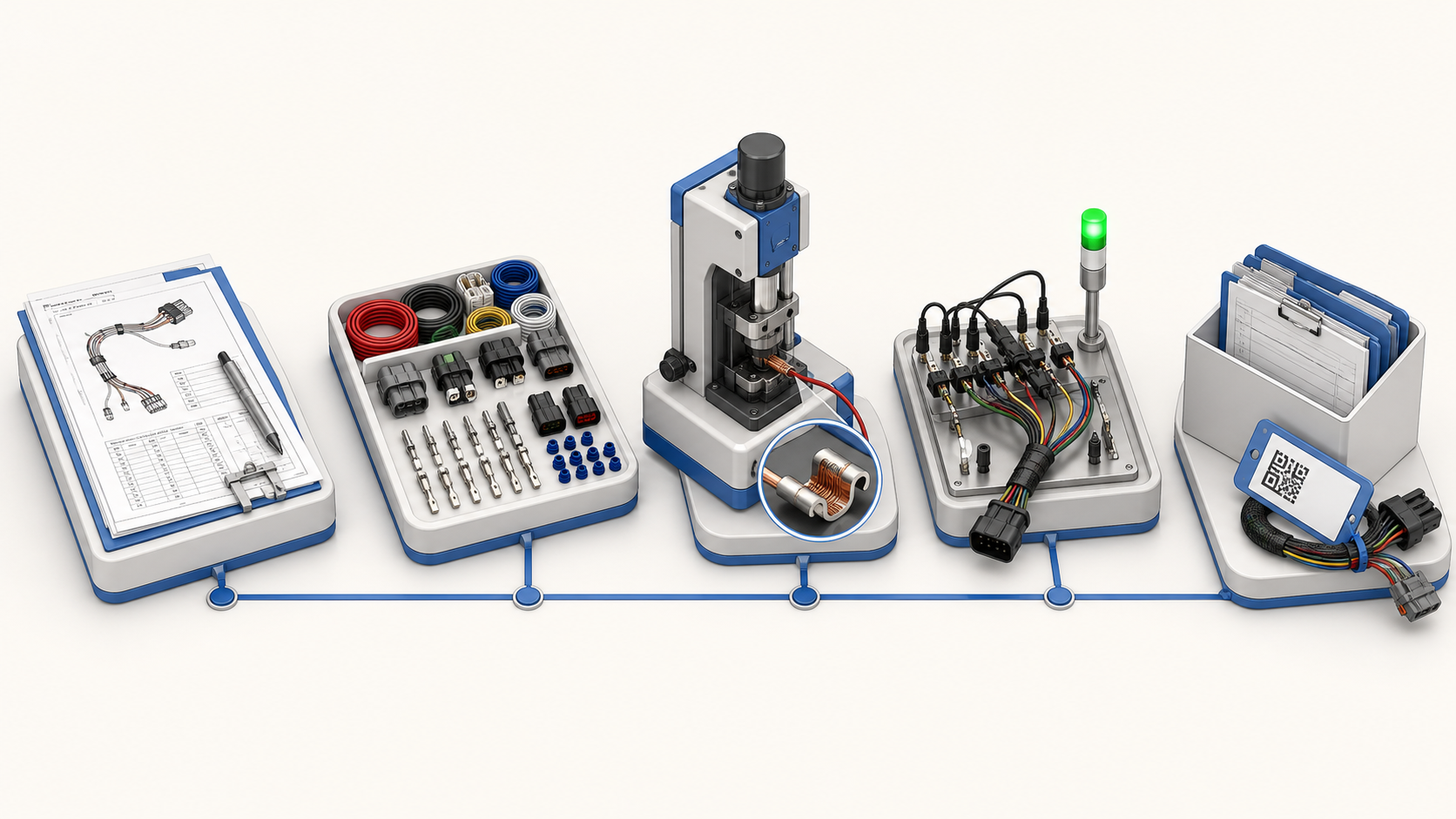
Mistake 1: Sending an Incomplete or Uncontrolled RFQ Package
An RFQ should define the electrical circuit, physical geometry, materials, application environment, expected volume, validation, and acceptance requirements. A schematic alone does not control branch dimensions, connector orientation, clips, labels, coverings, or tolerances. A sample alone does not reveal design intent. If information is missing, list it as an open item instead of allowing an assumption to become an invisible requirement.
A practical RFQ package normally includes:
- A harness drawing with dimensions, datums, tolerances, breakouts, connector orientation, clips, grommets, labels, protection, and revision status
- A circuit table or pinout that identifies connector cavities, wire identification, conductor size, color, function, and termination at both ends
- A BOM with manufacturer part numbers, applicable specifications, approved alternatives, and customer-supplied items
- Electrical loads, voltage, current, duty cycle, grounding, shielding, communication, and allowable voltage-drop information where relevant
- Environmental zones and exposure to heat, cold, water, dust, fluids, chemicals, abrasion, vibration, and repeated flexing
- Prototype and production quantities, annual demand, delivery destinations, packaging, service demand, and required dates
- Applicable workmanship, customer, regulatory, and validation requirements with revision levels
- Required test coverage, reports, material declarations, first-article documents, control plans, or PPAP elements
Assign one released revision list to the RFQ. If a drawing says revision C, the BOM says revision B, and a follow-up email changes a connector, neither the supplier nor the buyer has a reliable quotation baseline. Require an assumptions-and-exceptions list with the quote so unresolved items remain visible.
Mistake 2: Comparing Prices Before Normalizing Quote Scope
The lowest unit price is not necessarily the lowest evaluated cost. One quote may include test fixtures, 100% continuity testing, labels, documentation, and export packaging; another may exclude them or price them later. Engineers and buyers should normalize technical and commercial scope before selecting a supplier, then evaluate lifecycle cost, engineering effort, quality risk, and schedule exposure alongside piece price.
Use one comparison sheet for all bidders. Do not fill blank cells with assumptions; send questions back to the supplier.
| Quote element | Questions that make bids comparable | Common hidden cost |
|---|---|---|
| Components | Are manufacturer part numbers identical? Are alternates proposed? | Lower-grade or differently plated parts, spot-buy risk |
| Tooling | What is new, reusable, customer-owned, or amortized? | Applicators, fixtures, form boards, test adapters |
| Testing | Which circuits and characteristics are tested, at what limits and frequency? | Programming, fixtures, destructive tests, retained records |
| Documentation | Which submissions and reports are included? | First article, capability data, material declarations, PPAP |
| Nonrecurring engineering | What review, drawing conversion, or test development is included? | Repeated engineering charges after award |
| MOQ and packaging | What are order multiples, pack quantities, and preservation requirements? | Excess inventory, repacking, corrosion or shipping damage |
| Lead time | Does it include long-lead components and customer approvals? | Expedites, premium freight, line-down exposure |
| Delivery terms | Which freight, duty, insurance, and destination costs apply? | Landed-cost differences |
| Quality events | Who pays for sorting, rework, replacement, and return freight? | Unplanned containment cost |
| Change control | How are obsolescence, substitutions, and process moves handled? | Revalidation and emergency redesign |
The goal is not to eliminate all commercial variation. It is to know which variation you are buying. A higher quote may be the better decision if it closes a material risk with measurable controls; a lower quote may be valid if the buyer intentionally accepts or supplies part of the scope.
Mistake 3: Specifying Components by Appearance or Generic Description
Connector family names, photos, colors, and cavity counts are not reliable component definitions. Similar housings may differ in keying, polarization, material, sealing, temperature capability, terminal system, secondary locks, or mating interface. Define manufacturer part numbers and revisions wherever possible, verify the mating half, and document approved alternatives as complete compatibility decisions rather than casual equivalents.
The compatibility review should cover the housing, terminal, seal, cavity plug, lock, backshell, strain relief, wire range, insulation diameter, plating, and mating part. For sealed systems, the seal must match both the cavity and the actual cable insulation diameter. For mixed-current connectors, each circuit needs the correct terminal and conductor combination.
When an alternative is necessary, ask the supplier to identify every affected characteristic. “Form, fit, and function equivalent” is a conclusion that requires evidence, not a purchasing shortcut. Fit may require dimensional and mating checks; function may require electrical, thermal, mechanical, sealing, signal-integrity, or environmental evaluation.
Mistake 4: Ignoring Terminal, Wire, Seal, and Tool Compatibility
A crimp is a controlled system involving a specific terminal, wire conductor, insulation, seal when used, applicator, press setup, and inspection method. Selecting each item independently can create a combination that looks acceptable but falls outside the terminal manufacturer's application range. Require the applicable crimp specification, tooling identification, setup controls, measured characteristics, and evidence from production-intent samples.
Crimp height is important, but it is not the only characteristic. Conductor position, bellmouth, wire brush, cutoff tab, terminal deformation, insulation support, seal position, and damage also matter. Pull testing can reveal some problems, but it does not replace dimensional and visual controls, and a strong pull result alone does not prove the crimp is electrically or mechanically correct.
TE Connectivity's crimp quality guidance illustrates the dependency among terminal selection, wire selection, applicator condition, crimp height, conductor location, and insulation support. Use the current terminal-specific application specification as the controlling source whenever it is available.
Mistake 5: Treating a Certificate as Product Validation
A quality-system certificate describes a management-system scope; it does not prove that a particular harness meets its drawing, electrical loads, environmental conditions, or validation plan. Likewise, personnel training to a workmanship standard does not replace process evidence. Verify the certificate, issuing body, sites, scope, and expiration, then qualify the actual product and manufacturing process separately.
For automotive sourcing, customer-specific requirements may add obligations beyond a general quality-system baseline. The IATF customer-specific requirements directory shows that different vehicle manufacturers publish their own current documents. The applicable customer, program, supply-chain position, and contractual requirements must determine what is required.
Ask for a compliance matrix that maps each relevant requirement to one of four statuses: compliant with evidence, compliant by design, not applicable with rationale, or open action with owner and due date. This is more useful than a folder of certificates that have not been connected to the part number.
Mistake 6: Leaving Test Coverage and Acceptance Limits Undefined
The word “tested” is incomplete unless the contract defines the characteristic, method, limit, frequency, fixture, record, and reaction to failure. Continuity testing may detect opens and miswires but does not automatically verify contact resistance, insulation resistance, dielectric withstand, seal performance, pull strength, dimensions, or environmental durability. Select tests from the product's actual failure risks.
IPC/WHMA-A-620E establishes practices, requirements, tests, and acceptability criteria for cable and wire harness assemblies. IPC also states that the standard does not specify the frequency of in-process or finished-product inspection. The buyer and supplier must therefore define inspection and test frequency in the control plan or purchase requirements.
For each test, specify:
- The feature or failure mode being controlled
- The applicable method, equipment, and fixture
- Numeric limits or clear attribute criteria
- Whether testing is 100%, sampled, first-article, periodic, or validation-only
- Calibration and verification expectations
- The record linked to part, revision, lot, machine, or serial number
- The containment, investigation, and disposition required after a failure
Do not add high-voltage or destructive tests by habit. An inappropriate test can damage a product or create false confidence. The responsible engineer should set levels and methods from insulation-system ratings, circuit function, governing specifications, and risk analysis.
Mistake 7: Approving a Prototype That Does Not Represent Production
A prototype proves little about production capability if it uses hand tools, temporary components, special rework, or inspection that will not exist at volume. Before approval, identify every deviation from the planned BOM, tooling, location, operator method, fixture, test program, and documentation. Treat the production-intent first article as a separate release gate when the early prototype is exploratory.
Early samples are valuable for routing, interface, and functional learning. The mistake is allowing their purpose to drift. Label prototypes by build stage—for example, fit sample, functional sample, engineering validation build, production-intent first article—and define what each stage may approve.
A production-intent approval should verify the released revision, approved materials, normal work instructions, normal tooling, trained operators, form board or fixture, test program, packaging, and traceability. Record deviations rather than hiding them in email. If a late deviation affects a critical interface or validated characteristic, define the required requalification before shipment.
Mistake 8: Allowing Substitutions and Engineering Changes Without Control
An apparently minor change to wire, terminal plating, connector resin, seal, tape, sleeve, crimp tool, production location, or test method can affect fit, performance, validation, and compliance. Require written notification and approval before implementation. The change record should explain the reason, affected part numbers, inventory disposition, technical impact, validation evidence, timing, and traceability of the first changed lot.
Change rules should cover buyer changes, supplier proposals, component discontinuance, sub-tier changes, process moves, tooling replacement, drawing corrections, and temporary deviations. They should also define emergency handling so schedule pressure does not bypass engineering review.
A controlled change has a clear before-and-after configuration. The supplier should not ship a mixed revision unless the buyer authorizes it and can identify the affected units. The buyer should also close the loop by updating drawings, BOMs, test programs, receiving criteria, and service documentation.
Mistake 9: Ignoring Availability, MOQ, and Component Lifecycle
A technically correct BOM can still be commercially unbuildable. Long lead times, minimum order quantities, allocation, end-of-life status, packaging multiples, and counterfeit exposure can dominate schedule and cost. Review supply risk before design release, distinguish franchised or approved channels from unverified sources, and qualify alternates while the original component is still available—not during a shortage.
The sourcing review should identify single-source components, customer-controlled parts, constrained tooling, minimum buys, shelf-life items, country-of-origin restrictions, and demand volatility. Compare the forecast with supplier MOQs and pack quantities. A low annual demand can create excess inventory that needs agreed ownership, storage, preservation, and obsolescence terms.
Avoid vague blanket approval for “equivalents.” Maintain an alternate-part list tied to the exact harness revision and the evidence required for use. If no alternate is approved, state that fact and define the escalation path for a shortage.
Mistake 10: Using a Physical Sample as the Only Master
A physical harness can help reconstruct geometry, but it cannot reliably communicate design intent, original tolerances, electrical ratings, material identity, revision status, or acceptable wear. Reverse engineering should produce a controlled drawing, circuit table, BOM, and open-issue list. The buyer must review and release that definition before the sample becomes a production reference.
Samples may contain field damage, prior repairs, stretched branches, faded markings, non-original substitutions, or production defects. Measure more than one unit when possible, compare the sample with the installation and mating hardware, and distinguish observed construction from required construction.
Photographs are useful supplementary records, especially for routing and connector orientation, but they should not replace dimensions or acceptance criteria. Once the reconstructed package is approved, manage future changes through the documents rather than repeatedly copying a physical artifact.
Mistake 11: Overlooking Tooling Ownership, Capacity, and Continuity
Supplier capability must match both the initial build and the production ramp. Confirm which applicators, presses, fixtures, form boards, test adapters, and software are required; who owns them; where they are stored; how they are maintained; and whether they can be transferred. Capacity evidence should reflect product mix, uptime, changeovers, yield, labor, and constrained processes—not only theoretical machine speed.
Ask the supplier to explain capacity at the expected demand, peak demand, and recovery demand after disruption. Identify shared bottlenecks such as a single applicator, tester, overmold tool, approved sub-tier, or trained specialist. Review preventive maintenance, spare strategy, backup equipment, and business-continuity actions in proportion to program risk.
Tooling ownership terms should cover identification, maintenance, modification approval, insurance, access, end-of-life handling, and transfer. These details feel administrative until a supplier change, insolvency, capacity constraint, or emergency makes them critical.
Mistake 12: Skipping Traceability and Incoming Acceptance Planning
Without agreed traceability and receiving criteria, a buyer may know that a harness failed but not which material lot, machine, operator, revision, or shipment shares the risk. Define the traceability level from safety, regulatory, customer, and containment needs. Also define what incoming inspection verifies so the buyer does not duplicate controls blindly or discover missing evidence after delivery.
Traceability may be by shipment, manufacturing lot, date code, or individual serial number. More detail is not automatically better; it adds labeling, data, storage, and scanning cost. Choose the level that supports credible containment and record retention.
Incoming acceptance can verify identity, revision, packaging, labels, documentation, critical dimensions, mating, and selected electrical or workmanship characteristics. It does not excuse weak supplier controls. Align supplier records and buyer checks so that critical risks have an owner and failures trigger a defined response.
What Sourcing Gate Should Engineering and Purchasing Use?
A useful sourcing gate does not ask whether the team “likes” the supplier. It asks whether objective evidence is sufficient for the next commitment. Separate RFQ release, supplier selection, prototype approval, production-intent approval, and volume release. Each gate should have an owner, required inputs, unresolved-risk list, and written decision, including conditions or deviations.
| Gate | Minimum decision evidence | Release question |
|---|---|---|
| RFQ release | Drawing, BOM, pinout, environment, volumes, tests, deliverables, open-items list | Can suppliers quote the same defined scope? |
| Supplier selection | Normalized quotes, technical review, capability evidence, certificate verification, risk register | Can this supplier control the required product and process? |
| Prototype build | Approved build package, purpose, deviations, inspection and test plan | What exactly is this sample intended to prove? |
| Production-intent first article | Released parts, normal tools and process, dimensional and electrical records, deviation closure | Does the approved configuration represent serial production? |
| Volume release | Control plan, work instructions, capacity, traceability, packaging, change control, issue closure | Is repeatable production supported by evidence? |
| Ongoing supply | Performance review, audit actions, calibration, change notices, supply and lifecycle risks | Are controls still effective as conditions change? |
Keep the gate proportional to risk. A low-volume internal fixture does not need the same evidence as a safety-related vehicle assembly. The principle remains the same: requirements, risks, controls, evidence, and authority must be explicit.
How Can Engineers Improve a Custom Wire Harness RFQ?
Engineers can improve an RFQ by making ambiguity measurable. Provide a controlled package, identify missing inputs, rank critical characteristics, state the installation environment, and ask each bidder to return assumptions and exceptions in the same format. Invite manufacturability questions before design freeze, but require all accepted recommendations to enter the controlled drawing, BOM, or specification.
Before sending the RFQ, perform this short review:
- Can a supplier identify every electrical connection without interpreting a photograph?
- Can production reproduce every important branch, breakout, orientation, and attachment point?
- Are exact components or controlled alternatives named?
- Are the application environment and failure consequences clear?
- Does the test plan include methods, limits, frequency, records, and reactions?
- Are prototype purpose, production-intent approval, and volume release separated?
- Are quote inclusions, exclusions, tooling, MOQ, lead time, packaging, and delivery terms comparable?
- Are substitutions, deviations, and permanent changes subject to written approval?
For a broader description of custom build capabilities, review OUKETECH's custom wiring harnesses and custom cable assemblies pages. Engineers deciding between those product categories can also use the cable assembly vs. wire harness guide.
How Can OUKETECH Support a Lower-Risk Sourcing Process?
OUKETECH's published service pages describe custom wire-harness and cable-assembly support from project review through prototyping, manufacturing, and electrical testing. For a specific project, the useful next step is a documented technical review—not a generic capability claim. Send the drawing, BOM, pinout, environment, quantities, required tests, and unresolved questions so scope and evidence can be agreed before quotation.
Projects with vehicle-specific requirements can start with the automotive wiring harness page. Buyers evaluating broader OEM support can review OEM cable manufacturing, while sealed or strain-relieved constructions may also require the overmolded cable assemblies capability page.
OUKETECH should confirm all project-specific materials, standards, testing, documentation, capacity, and certification scope during quotation. No website statement should replace the released customer specification or written project agreement. To request a review, use the current contact page and attach enough technical information for the team to identify assumptions and open risks.
Frequently Asked Questions
The most frequent sourcing questions concern the minimum RFQ package, quote comparison, supplier certificates, prototypes, test coverage, and substitutions. The answers below provide a decision starting point, but the final requirement must reflect the harness application, governing documents, customer obligations, and consequences of failure.
What is the biggest mistake when sourcing a custom wire harness?
The biggest mistake is awarding the project before technical scope is controlled. An incomplete drawing, BOM, pinout, environment, or test requirement forces bidders to make different assumptions. The resulting prices are not comparable, and the missing decisions reappear later as engineering changes, delays, failures, or extra charges.
What should be included in a wire harness RFQ?
Include a revision-controlled drawing, circuit or pinout data, BOM with manufacturer part numbers, electrical loads, installation environment, applicable standards, inspection and test requirements, quantities, forecast, schedule, packaging, delivery terms, documentation, and an open-items list. Ask the supplier to return assumptions, exceptions, and proposed alternatives explicitly.
Is IPC/WHMA-A-620 certification enough to qualify a supplier?
No. IPC/WHMA-A-620 is an important workmanship and acceptance reference, and personnel training can support consistent interpretation. Supplier qualification must still evaluate the actual site, process, equipment, quality controls, certificate scope, traceability, capacity, and project-specific validation. The product specification must also define class, revision, inspection frequency, and other applicable requirements.
Should every wire harness receive continuity testing?
Test frequency should be defined from risk, customer requirements, production controls, and the applicable contract. Continuity testing is common and valuable, but it only addresses specified electrical connection errors. It does not automatically validate dimensions, crimp quality, contact resistance, insulation, sealing, material identity, or environmental performance.
Can a supplier substitute an equivalent connector or wire?
Only through the agreed change process. The supplier should provide exact proposed part numbers, reasons, affected characteristics, compatibility evidence, validation needs, inventory impact, and implementation timing. The responsible customer authority should approve the change in writing before shipment, and controlled documents should record the accepted configuration.
What is the difference between a prototype and a production-intent first article?
A prototype may use temporary materials, hand processes, or special inspection to answer design questions. A production-intent first article uses the released BOM, normal tooling, normal process, planned location, test program, packaging, and traceability. The latter provides stronger evidence that volume production can reproduce the approved design.
How should engineers compare wire harness supplier quotes?
Normalize component part numbers, tooling, test coverage, engineering work, documentation, MOQ, packaging, lead time, freight, duty, quality-event responsibility, and change-control terms. Record all exclusions and assumptions. Compare total evaluated cost and technical risk, not unit price alone.
When should a sourcing team audit a wire harness supplier?
Audit depth should match product and business risk. An audit is most useful before a high-consequence award, when evidence cannot be verified remotely, after major quality concerns, or before a significant process or site change. Focus on the actual processes, records, equipment, people, sub-tier controls, and capacity relevant to the proposed harness.