

Table of Contents
- Introduction
- What Is a Power Cord?
- Power Cord Standards: NEMA, IEC 60320, and International Plug Types
- Wire Gauge, Voltage Drop, and Ampacity
- Jacket Materials and Cord Construction
- How to Choose the Right Power Cord
- Common Applications
- Power Cords in Custom Cable Assemblies
- Conclusion
Introduction
Related OUKETECH resources: industrial wire harness manufacturing.
Plug the wrong power cord into your equipment, and you’re looking at a fire hazard.
Not a dramatic statement, just physics. A cord rated for 10 amps won’t survive long on a circuit pulling 15. The jacket that works fine in an air-conditioned office will crack after one winter outdoors. These aren’t edge cases. They’re the daily reality for anyone specifying power cords for industrial equipment, medical devices, or data center infrastructure.
A power cord is a portable cable assembly that connects electrical equipment to a mains power source. It’s the last few feet between the wall outlet and your device, and it’s also the component most likely to be overlooked until it fails.
This guide covers what power cords are, the standards that govern them, how wire gauge and voltage drop affect performance, what jacket materials to choose, and how to select the right cord for your application. We’ll also look at how custom cable assembly manufacturers integrate power cords into complete solutions, because off-the-shelf doesn’t always cut it.
What Is a Power Cord?
A power cord is a detachable or permanently attached cable assembly that transfers electrical power from a wall outlet or power distribution unit to a piece of equipment. It consists of four essential components:
- Plug (male end): The connector that inserts into the wall outlet. Its shape and pin configuration are dictated by regional standards: NEMA in North America, CEE 7/7 in Europe, BS 1363 in the UK.
- Cord/cable: The flexible conductor assembly between plug and connector. It contains two or three insulated copper conductors (hot, neutral, and optionally ground), wrapped in a protective outer jacket.
- Strain relief: The molded or mechanical feature where the cable enters the plug or connector body. It prevents the conductors from bending sharply and breaking at the termination point, which is the most common failure site on any power cord.
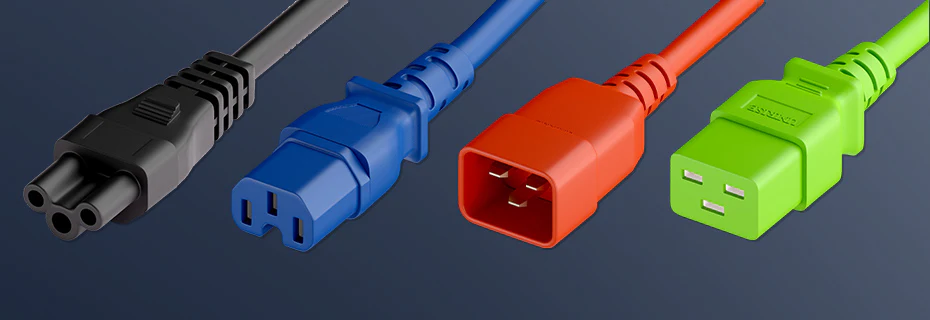
- Connector (female end): The receptacle that mates with the equipment inlet. For detachable cords, this is typically an IEC 60320 connector (C13, C15, C19, etc.).
AC vs DC Power Cords
Most power cords carry alternating current (AC) from the wall to the device. The device’s internal power supply then converts AC to DC. However, DC power cords exist for applications like solar installations, battery banks, and telecommunications equipment where power is distributed as DC. The key difference: AC cords typically use three conductors (hot, neutral, ground), while DC cords use two (positive, negative). DC cords also don’t require the same safety certifications for grounding since there’s no ground conductor.
Detachable vs Hard-Wired
Detachable power cords use an appliance inlet (IEC C14, for example) on the equipment side, letting you swap cords for different regions or replace a damaged cord without opening the equipment. Hard-wired cords are permanently attached inside the device. This is common in appliances like refrigerators, power tools, and industrial machinery where a loose connection could create a hazard. Detachable cords offer flexibility; hard-wired cords offer reliability. The application dictates the choice.
Power Cord Standards: NEMA, IEC 60320, and International Plug Types
Power cords look simple. They’re not. Every plug shape, pin spacing, voltage rating, and current capacity is defined by a standard, and those standards differ by region. If you’re sourcing equipment for global distribution, you need to know which standards apply where.
NEMA Standards (North America)
NEMA (National Electrical Manufacturers Association) is the ANSI-accredited organization that defines plug and receptacle configurations for North America. NEMA connectors are categorized by two broad families: straight blade (non-locking) and locking.
Straight blade connectors are what you see on everyday power cords. The most common:
- NEMA 1-15P: Two-prong, non-grounded. Rated 15A / 125V. Found on older lamps, phone chargers, and small appliances. One prong is wider (polarized) to enforce hot/neutral orientation.
- NEMA 5-15P: Three-prong, grounded. Rated 15A / 125V. This is the standard North American household plug, used on computers, monitors, printers, and most consumer electronics.
- NEMA 5-20P: Three-prong, grounded. Rated 20A / 125V. One blade is horizontal (T-slot). Common in commercial kitchens, workshops, and hospital-grade receptacles.
- NEMA 6-15P: Three-prong, grounded. Rated 15A / 250V. Used for larger air conditioners, welders, and some server equipment running on 208–240V circuits.
Locking connectors (NEMA L-series) twist into place and won’t pull out accidentally. They’re standard in industrial environments, generator connections, and marine applications:
- NEMA L5-30P: Locking, 30A / 125V. Common on generators and temporary power distribution.
- NEMA L6-30P: Locking, 30A / 250V. Used for industrial equipment and server PDUs.
The NEMA numbering system follows a pattern: the first number (before the dash) indicates the configuration family (5 = 125V grounded, 6 = 250V grounded, L = locking variant). The second number is the amperage rating. The letter suffix identifies plug (P) or receptacle (R).
IEC 60320 (International)
IEC 60320 is the international standard for appliance couplers. These are the connectors you see on the equipment end of detachable power cords. Unlike NEMA, which covers the wall-plug side, IEC 60320 standardizes the interface between the cord and the device. This means a device with an IEC C14 inlet can accept power cords with NEMA 5-15P, CEE 7/7, BS 1363, or any other regional plug. Just swap the cord.
Common IEC 60320 connectors:
| Connector | Inlet | Rating | Typical Use |
|---|---|---|---|
| C13 / C14 | C14 inlet | 10A / 250V | Computers, monitors, printers, lab equipment |
| C15 / C16 | C16 inlet | 10A / 250V (120°C) | Electric kettles, high-temp appliances (notched to prevent C13 insertion) |
| C19 / C20 | C20 inlet | 16A / 250V | Servers, UPS systems, high-power PDUs |
| C5 / C6 | C6 inlet | 2.5A / 250V | Laptop power bricks (“Mickey Mouse” connector) |
| C7 / C8 | C8 inlet | 2.5A / 250V | Small electronics, game consoles, DVD players (figure-8) |
The C15/C16 pair deserves special mention. The C15 connector has a notch that prevents it from mating with a standard C14 inlet, but a C13 cord can plug into a C16 inlet. This is intentional: the C15 is rated for higher temperatures (120°C vs 70°C for C13), so you can use a high-temp cord on standard equipment but not the reverse.
International Plug Types
If your product ships globally, you’ll encounter these plug types. There are 14 recognized types (A through O), but these are the ones you’ll actually see in production:
- Type A (NEMA 1-15): Two flat parallel pins, non-grounded. 100–127V / 15A. North America, Japan, Mexico. Japan’s version has identical pin widths (non-polarized).
- Type B (NEMA 5-15): Two flat parallel pins + round ground pin. 100–127V / 15A. North America, Mexico, parts of South America.
- Type C (CEE 7/16 “Europlug”): Two round pins, non-grounded. 220–240V / 2.5A. Used throughout Europe for low-power devices. Fits Type E, F, and some other sockets.
- Type E (CEE 7/5): Two round pins + socket-mounted ground pin. 220–240V / 16A. France, Belgium, Poland, Czech Republic.
- Type F (CEE 7/4 “Schuko”): Two round pins + side grounding clips. 220–240V / 16A. Germany, Austria, Netherlands, Sweden, and most of continental Europe.
- Type G (BS 1363): Three rectangular pins in triangular pattern, fused. 220–240V / 13A. UK, Ireland, Singapore, Hong Kong, UAE.
- Type I: Two flat angled pins + ground pin. 220–240V / 10A. Australia, New Zealand, China, Argentina.
Voltage and frequency vary by region: North America runs 100–127V at 60Hz. Most of the rest of the world runs 220–240V at 50Hz. Japan is the outlier: 100V at both 50Hz (east) and 60Hz (west). Always check the equipment’s input rating before plugging in.
Wire Gauge, Voltage Drop, and Ampacity
The wire inside a power cord isn’t one-size-fits-all. Thicker wire carries more current with less resistance. Thinner wire is cheaper, lighter, and more flexible, but it heats up faster and drops more voltage over distance. The AWG (American Wire Gauge) system is the standard for specifying conductor size in North America.
The AWG System
AWG is counterintuitive: a smaller number means a thicker wire. 10 AWG is a thick conductor (2.59mm diameter). 18 AWG is thin (1.02mm). Each 3-gauge decrease roughly doubles the cross-sectional area.
Common power cord gauges:
| AWG | Diameter (mm) | Typical Ampacity (copper) | Common Application |
|---|---|---|---|
| 18 AWG | 1.02 | 10A | Light-duty: lamps, phone chargers, small electronics |
| 16 AWG | 1.29 | 13A | Medium-duty: monitors, printers, household appliances |
| 14 AWG | 1.63 | 15–18A | Power tools, extension cords, air conditioners |
| 12 AWG | 2.05 | 20–25A | Heavy-duty: industrial equipment, long extension cords |
| 10 AWG | 2.59 | 30A | Server PDUs, welding equipment, generator cords |
These ampacity ratings assume copper conductors at 60°C ambient with standard PVC insulation. Higher-temperature insulation (silicone, Teflon) allows higher ampacity for the same gauge.
Voltage Drop: Why Cord Length Matters
Every conductor has resistance. The longer the cord, the higher the resistance, and the more voltage you lose between the outlet and the equipment. For a 120V circuit, losing 3–5 volts might not matter for a lamp. For sensitive electronics or motors, it can cause erratic behavior or overheating.
The voltage drop formula:
V_drop = 2 × L × R × I / 1000
Where:
- L = one-way cable length in feet
- R = conductor resistance in ohms per 1000 feet (from AWG tables)
- I = current in amps
- Multiply by 2 because current travels round-trip (hot + neutral)
Practical rule: keep power cords under 50 feet for standard gauges. If you need a longer run, go up at least one AWG size (thicker wire). A 100-foot 16 AWG cord pulling 10 amps drops about 8 volts on a 120V circuit. That’s nearly 7%. The same run in 14 AWG drops about 5 volts. For 50-foot runs at 15 amps, 14 AWG is the minimum; 12 AWG is better.
For data center and industrial applications where equipment draws 15–20 amps continuously, 12 AWG or 10 AWG cords are standard, not optional.
Jacket Materials and Cord Construction
The outer jacket isn’t just a wrapper. It determines where the cord can be used, what chemicals it can withstand, and how long it’ll last.
Common Jacket Types
SVT (Service Vacuum Thermoplastic): Light-duty PVC jacket, typically 18–16 AWG. Rated for indoor use only. You’ll find this on vacuum cleaners, office equipment, and consumer electronics. Maximum temperature: 60–105°C depending on the specific compound. Not oil-resistant.
SJT (Service Junior Thermoplastic): Medium-duty PVC jacket, 18–10 AWG. More durable than SVT, with better abrasion resistance. Used on power tools, extension cords, and general-purpose industrial cords. Rated 60–105°C.
SJOOW / SOOW: Heavy-duty thermoset (rubber) jacket. The “OO” means oil-resistant insulation and oil-resistant jacket. The “W” means water-resistant and rated for outdoor use. SOOW is the workhorse of industrial power cords: flexible in cold weather, resistant to oil, water, ozone, and abrasion. Rated for 600V. Common in construction sites, mining equipment, and portable generators.
PVC (Polyvinyl Chloride): The most common jacket material. Cheap, flame-retardant, and adequate for indoor use. The downside: it stiffens in cold weather and can crack if flexed repeatedly below freezing. Maximum continuous temperature is typically 105°C.
Rubber (EPDM, Neoprene): More expensive than PVC but far more flexible, especially in cold weather. Rubber-jacketed cords stay pliable at -40°C where PVC would be brittle. Neoprene adds oil and chemical resistance. These are the cords you want for outdoor industrial use.
Shielded vs Unshielded
Most power cords are unshielded. They don’t need to be. The 50/60Hz AC waveform isn’t particularly noisy, and the equipment’s internal power supply filters out what little interference exists.
Shielded power cords add a braided copper or aluminum foil layer between the conductors and the jacket. This matters when:
- The equipment is sensitive to electromagnetic interference (EMI), such as medical imaging, precision measurement, and audio recording
- The cord runs near data cables and you want to prevent cross-talk
- Regulatory requirements (FCC, CE) mandate reduced emissions
The trade-off: shielded cords are stiffer, more expensive, and the shield must be properly terminated to ground at one or both ends. An improperly grounded shield can act as an antenna and make interference worse.
Conductor Count and Right-Angle Plugs
Two-conductor cords (hot + neutral, no ground) are for double-insulated devices that don’t require a safety ground. You’ll see these on phone chargers, lamps, and small appliances with plastic housings.
Three-conductor cords (hot + neutral + ground) are required for any device with a metal chassis or exposed conductive parts. The ground conductor provides a low-resistance path to earth if a fault energizes the chassis.
Right-angle plugs solve a practical problem: space. When equipment sits flush against a wall, a straight plug sticks out and gets crushed. A right-angle plug (also called a 90-degree plug) routes the cord parallel to the wall, saving several inches of clearance. Common orientations: down, left, right, and 45-degree angles. For rack-mounted equipment in data centers, right-angle C13 and C19 connectors prevent the cord from blocking adjacent rack units.
How to Choose the Right Power Cord
Selecting a power cord isn’t complicated if you work through it systematically. Here’s the six-step process:
- Match the plug type to your region’s outlet.If the equipment ships to North America, you need NEMA 5-15P or 5-20P. For Europe, CEE 7/7 (“Schuko”) or the specific national variant. For the UK, BS 1363 with the built-in fuse. Don’t guess. Check the destination country’s standard.
- Match the connector type to your device’s inlet.Look at the equipment’s power inlet. If it’s a rectangular three-pin socket, it’s almost certainly an IEC C14 (accepts C13 cord). If it’s a larger rectangular socket, it’s likely a C20 (accepts C19 cord). Laptop power bricks use C6 (accepts C5 “Mickey Mouse” cord) or C8 (accepts C7 figure-8 cord).
- Check voltage and amperage ratings.The cord must be rated for at least the voltage and current the equipment draws. A cord rated 10A/125V will fail on a 15A circuit. Always include a safety margin. If the equipment draws 12A continuous, use a 15A-rated cord, not a 13A cord running at 92% of its rating.
- Select wire gauge based on load and length.For runs under 6 feet, 18 AWG handles 10A and 16 AWG handles 13A. For 25-foot runs at 15A, step up to 14 AWG. For 50-foot runs, 12 AWG. When in doubt, go one gauge thicker than the minimum. The cost difference is small, and the safety margin is worth it.
- Choose jacket material for the environment.Indoor, climate-controlled? SVT or SJT PVC is fine. Outdoor, wet, or oily? SOOW rubber. Cold environment? Rubber stays flexible; PVC doesn’t. Medical environment? Hospital-grade cords with clear plugs (for visual inspection) and higher plug retention force.
- Verify safety certifications.Look for certification marks on the plug and jacket:
- UL (Underwriters Laboratories):Required for North America
- CSA (Canadian Standards Association):Required for Canada
- VDE (Verband der Elektrotechnik):Required for Germany and widely accepted across Europe
- CE Marking:Required for the European Union (self-declaration, not third-party certification)
- CCC (China Compulsory Certification):Required for China
Common Applications
Power cords show up everywhere, but the requirements shift dramatically by industry.
Consumer Electronics: Computers, monitors, TVs, and gaming consoles almost universally use IEC C13 cords with NEMA 5-15P plugs in North America. These are commodity items: 18 AWG, SVT jacket, 6-foot length. Nothing special, but volume is enormous.
Household Appliances: Dryers and electric ranges use NEMA 14-30P (30A/250V) or 10-30P plugs with heavy-gauge conductors. Refrigerators and washing machines use NEMA 5-15P with 16–14 AWG cords. These are typically hard-wired or use appliance-specific connectors rather than IEC.
Medical Devices: Hospital-grade power cords are a distinct category. They use clear (transparent) plugs so staff can visually inspect the internal connections. The plug blades are solid brass (not folded) for higher durability. The ground pin has higher retention force in the receptacle. They’re marked with a green dot and must meet UL 817 and CAN/CSA C22.2 No. 21 standards. In operating rooms and ICUs, these cords often use locking connectors to prevent accidental disconnection.
Industrial Equipment: This is where SOOW jacket cords dominate. Industrial environments expose cords to oil, cutting fluids, metal shavings, and constant flexing. A standard PVC cord would fail in weeks. SOOW cords with 12–10 AWG conductors, often with twist-lock NEMA L-series plugs, are standard. For equipment that moves (conveyors, portable tools), high-flex stranded conductors with extra-fine stranding (Class K) prevent work-hardening and breakage.
Data Centers: The data center power cord landscape is dominated by IEC C13 and C19 connectors. A typical rack PDU (power distribution unit) might have 24 or 42 C13 outlets and 6 C19 outlets. Color-coded cords (red, blue, yellow, green) help identify redundant power feeds (A-side vs B-side). Right-angle connectors prevent blocking adjacent outlets. Cable management arms and vertical PDU mounting require specific cord lengths: 2-foot cords for short vertical runs, 10-foot cords for overhead cable trays.
Telecommunications: Telco equipment often uses -48V DC power distribution rather than AC. DC power cords in telecom use specialized connectors (Anderson Powerpole, barrel connectors, terminal lugs) and heavier gauges because DC systems run at lower voltage and higher current for the same power.
CNC Machining: Power and control wiring for CNC machine controllers, servos and encoders; engineered for drag-chain flexing, coolant resistance and EMI shielding.
Off-the-shelf power cords work for most consumer and office applications. But when you’re building industrial equipment, medical devices, or specialized electronics, standard cords create more problems than they solve. This is where custom cable assembly manufacturing comes in.
Power Cords in Custom Cable Assemblies
Beyond the Catalog Part
A custom cable assembly manufacturer doesn’t just crimp connectors onto wire. The process starts with your specifications (the exact plug type, connector, wire gauge, jacket material, length, labeling, and certifications) and builds to print. No substitutions, no “close enough.” For OEMs shipping products globally, custom cable assemblies mean you get the exact cord configuration for each destination market without maintaining inventory of dozens of SKUs.
Quality Standards That Matter
Reputable manufacturers build to IPC/WHMA-A-620 (the standard for cable and wire harness assemblies) and maintain ISO 9001 certification. These aren’t marketing badges. They define acceptance criteria for crimp quality, solder joints, insulation placement, and strain relief. A power cord built to IPC-620 Class 3 (the highest level, for critical applications) has tighter tolerances and more rigorous inspection than a commodity cord.
For OEM programs, OEM cable manufacturers provide full traceability: lot-level material records, test data for every assembly, and documentation packages that satisfy regulatory audits. When a power cord is part of a medical device or industrial control system, that traceability isn’t optional. It’s a regulatory requirement.
Hospital-Grade Power Cords
Hospital-grade cords are a specialized subset of custom power cord manufacturing. What makes them different:
- Clear plugs for visual inspection of internal terminations
- Solid brass blades and contacts: no folded metal that can loosen over time
- Higher insertion/withdrawal force on the ground pin to ensure reliable grounding
- Strain relief tested to higher pull-force requirements
- Green dot marking indicating hospital-grade certification
- UL 817 and CAN/CSA C22.2 No. 21 compliance
These cords are integrated into larger custom wiring harnesses for medical carts, patient monitors, and imaging systems. The power cord isn’t a standalone component. It’s part of a complete electrical system where every connection is documented and tested.
Shielded Power Cords for Sensitive Equipment
When equipment operates near MRI machines, radio transmitters, or high-frequency switching power supplies, electromagnetic interference becomes a real problem. Shielded power cords add a braided copper shield between the conductors and the outer jacket, terminated to ground at the plug end. The shield attenuates both radiated emissions (keeping noise in) and susceptibility (keeping noise out).
Custom shielded power cords are often integrated with signal cables in a single overmolded cable assembly. Overmolding encapsulates the connector-to-cable junction in a single piece of thermoplastic or thermoset material, eliminating the weak point where a standard boot or backshell would be. The result: a sealed, strain-relieved, IP67-rated connection that handles power, signal, and shielding in one assembly.
Integration with Wire Harnesses
In many applications, power cords don’t exist in isolation. They’re part of a wiring harness, a complete electrical distribution system that routes power, signals, and data throughout a machine or vehicle. A custom cable assembly manufacturer that also builds wire harnesses can deliver the power cord pre-integrated with the harness, tested as a single unit, with a single part number and a single quality record.
This matters for production efficiency. Instead of receiving power cords from one supplier and harnesses from another, then connecting them on your assembly line, you receive one tested assembly. Fewer SKUs, fewer suppliers, fewer points of failure.
For equipment that uses multiple cable types (power cords alongside ribbon cable assemblies for internal signal routing, for example), a single manufacturer can deliver the complete interconnect solution.
What to Look for in a Custom Power Cord Supplier
- Build-to-print capability: They manufacture to your drawing, not their catalog
- IPC/WHMA-A-620 certification: With trained operators and documented process control
- In-house testing: 100% continuity, hipot, and pull-force testing on every assembly
- Material traceability: Lot-level records for wire, connectors, and jacket materials
- Certification support: UL, CSA, CE, VDE, CCC documentation
- Scalability: From prototype quantities to full production volumes
Conclusion
Power cords are simple components that carry serious consequences when specified wrong. The key takeaways:
- Match the plug to the region. NEMA for North America, CEE 7/7 for Europe, BS 1363 for the UK, and the appropriate national standard for every other market. One wrong plug type and the equipment can’t be plugged in.
- Check the gauge. 18 AWG works for 10A at short lengths. Step up to 14 AWG for 15A at 25 feet. Go to 12 AWG for long runs or continuous loads. The cost of thicker wire is trivial compared to the cost of a melted cord.
- Verify certifications. UL, CSA, VDE, CE, CCC. The marks on the cord are your proof that it’s been tested to the relevant safety standards. No marks, no confidence.
- Choose the jacket for the environment. Indoor office? SVT PVC is fine. Factory floor with oil and water? SOOW rubber. Hospital? Hospital-grade with clear plugs.
- Know when off-the-shelf works and when custom is necessary. For consumer electronics and standard office equipment, commodity cords are adequate. For industrial equipment, medical devices, and OEM products shipping globally, custom power cords built to your specifications, with full traceability and certification support, eliminate supply chain complexity and reduce liability.
Need custom power cords for your OEM product, medical device, or industrial equipment?
OUKETECH provides custom power cord and cable assembly solutions built to your specifications. From hospital-grade cords to shielded assemblies to fully integrated wire harnesses, we manufacture to your print with IPC/WHMA-A-620 quality standards and full material traceability. Contact our engineering team to discuss your requirements.