

When a customer asks us to quote a custom wire harness, the first question is not simply, “How many pieces do you need?” We first need to understand what the harness must connect, how it will be installed, which materials are specified and how the finished assembly must be tested.
A clear RFQ helps our engineering and sourcing teams prepare a more accurate quotation with fewer assumptions. It also helps us identify material risks, tooling needs and open design questions before they affect a prototype or production schedule. This guide explains what B2B buyers, engineers and project managers should send to a custom wire harness manufacturer when requesting a quote.
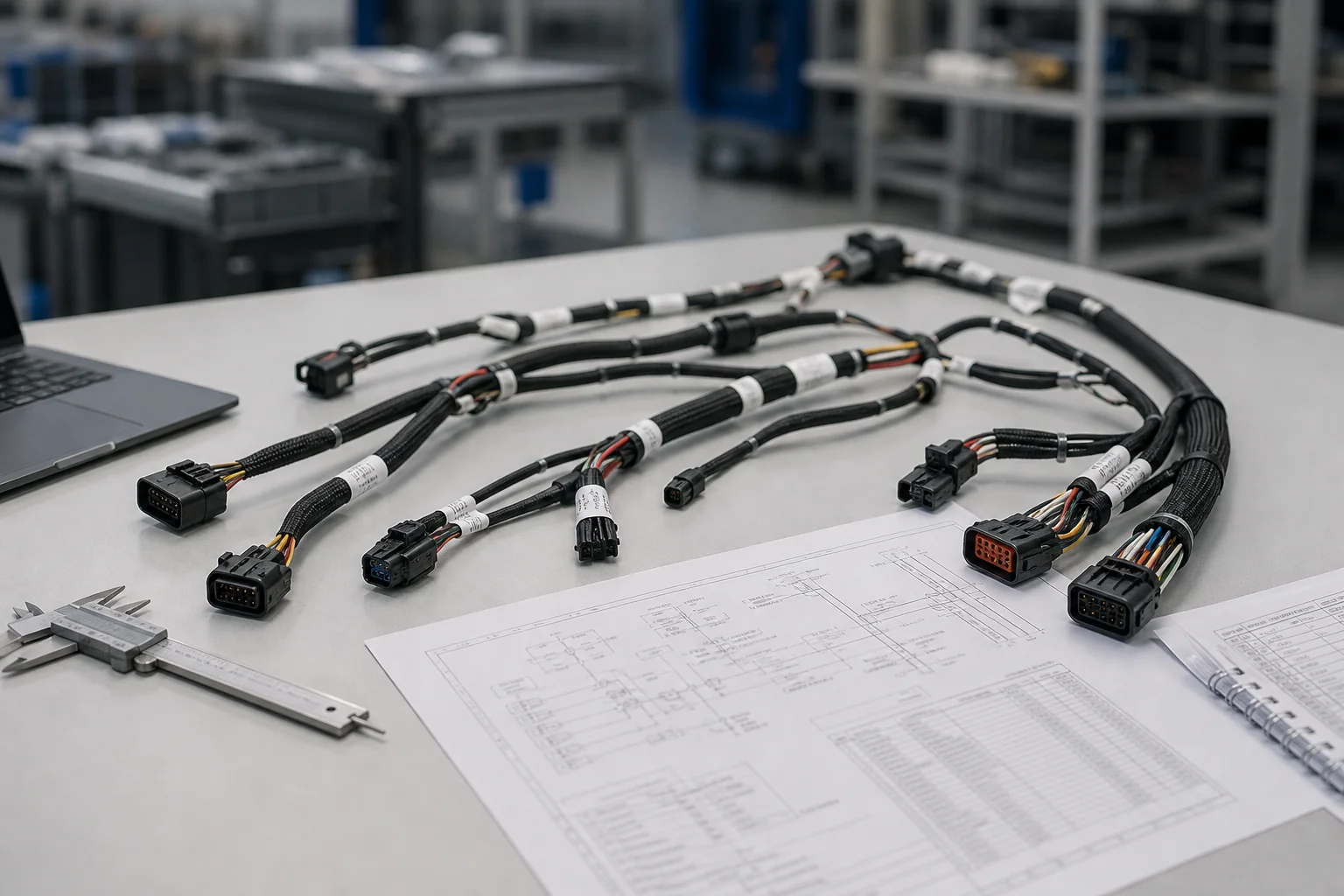
Custom Wire Harness RFQ Checklist
For the fastest and most useful review, include as many of the following items as your project allows:
- Harness drawing, electrical schematic, pinout or physical sample
- Bill of materials and specified manufacturer part numbers
- Wire gauge, type, color, length and electrical rating
- Connector, terminal, seal and accessory information
- Branch dimensions, tolerances, labels and protective materials
- Application, operating environment and installation conditions
- Applicable workmanship or customer specifications
- Electrical, dimensional and mechanical test requirements
- Prototype quantity, production order quantity and annual forecast
- Required delivery date, destination and packaging requirements
- Drawing revision and contact person for technical questions
1. Send a Drawing, Pinout or Reference Sample
A controlled drawing is the best starting point for a production quotation. It gives our engineering, purchasing, assembly and inspection teams the same definition of the product.
The drawing should identify connector positions, pin-to-pin connections, finished lengths, branch locations, tolerances, labels and protective covering. For multi-branch harnesses, show how each branch is measured and where dimensions begin and end. Include the drawing number and revision so that a later update can be tracked correctly.
A schematic or connection table is particularly important when the visible wire colors do not fully define the circuit. If the assembly contains resistors, diodes, fuses, switches or other components, show their value, orientation and location.
Can OUKETECH quote from a sample?
We can review an existing harness sample when no drawing is available. A sample helps us understand the general construction, connector arrangement, routing and workmanship. However, hidden connections, exact material grades and internal terminal details may not be verifiable from appearance alone. For repeat production, the customer and manufacturer should agree on a controlled drawing or approved specification before the design is released.
2. Provide Wire, Connector and BOM Details
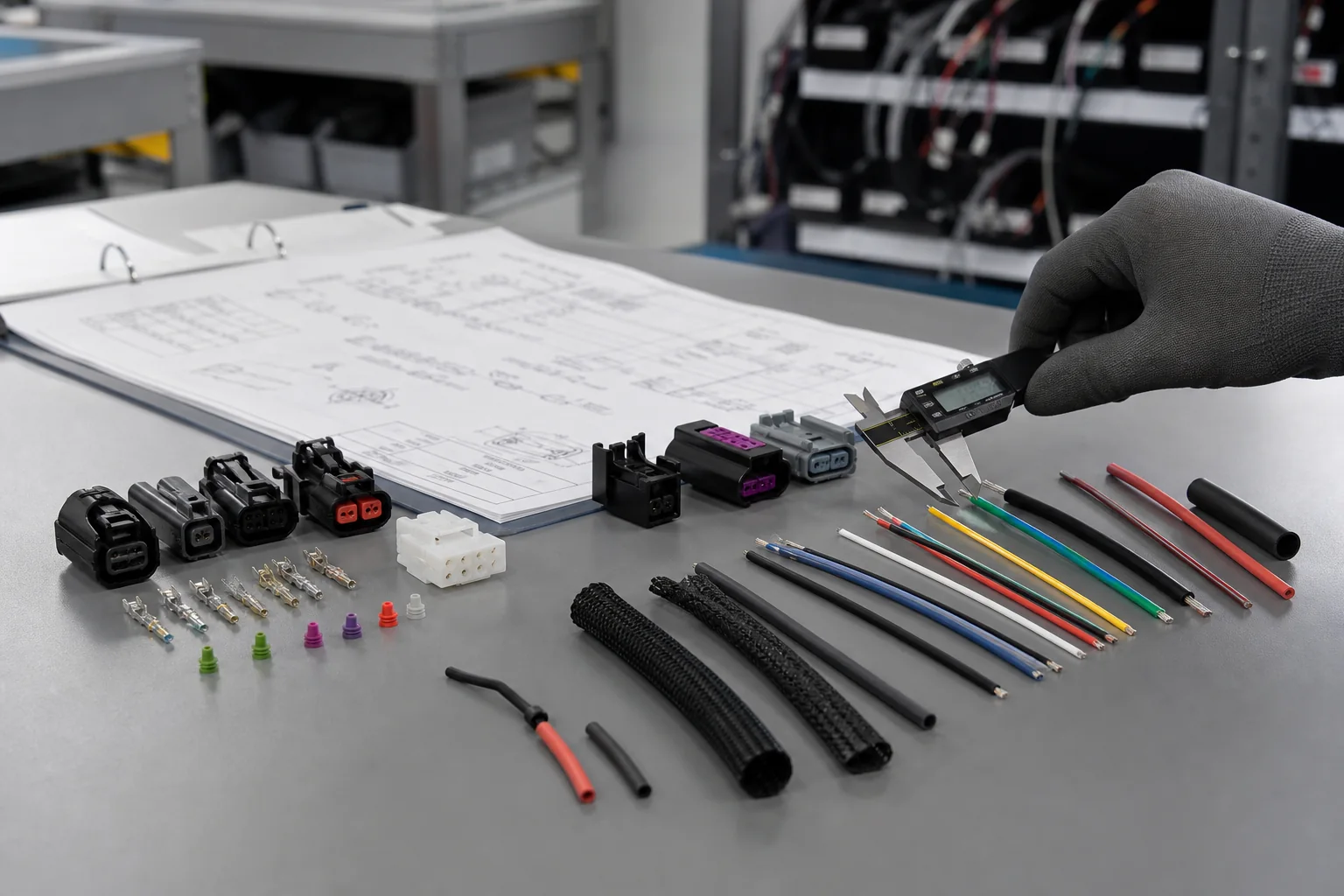
Materials can have a major effect on wire harness price and lead time. A description such as “red 18 AWG wire” does not identify conductor stranding, insulation material, temperature rating, voltage rating or required approvals. Where a specific component is mandatory, provide its full manufacturer part number.
| Component | Useful RFQ information | What it helps us confirm |
|---|---|---|
| Wire and cable | Part number, gauge, conductor, stranding, insulation, color, voltage, temperature and shielding | Electrical suitability, processing method and material availability |
| Connector housing | Manufacturer, full part number, keying, color, gender and mating connector | Mechanical compatibility and correct cavity arrangement |
| Terminal or contact | Part number, plating and compatible wire range | Crimp tooling, wire compatibility and sourcing |
| Seals and accessories | Cavity seals, plugs, locks, backshells, strain relief and mounting hardware | Whether the connector assembly is complete |
| Bundle protection | Sleeving, conduit, braid, tape, heat shrink, boots and grommets | Routing, abrasion protection, labor and finished bundle size |
| Identification | Label material, printed content, barcode, serial number and position | Marking method, traceability and inspection |
Please also tell us whether approved equivalents may be proposed. Some customers require the exact BOM; others allow an alternative connector, wire or protection material after engineering approval. Stating the substitution policy allows us to quote on the intended basis.
If your requirement is a cable rather than a multi-branch harness, our overview of custom cable assemblies explains common power, signal, data and specialty constructions. For programs manufactured to a customer-controlled design, see our OEM cable manufacturing capabilities.
3. Tell Us How and Where the Harness Will Be Used
Application information helps us review whether the specified materials and construction are consistent with the operating conditions. It does not need to reveal confidential details about the complete machine. The most useful information is what directly affects the wire harness.
- Indoor, outdoor, vehicle, enclosure or exposed installation
- Minimum and maximum operating temperature
- Water, dust, oil, fuel, chemicals or ultraviolet exposure
- Vibration, shock, abrasion or repeated flexing
- Voltage, current, signal type and data requirements
- Shielding, grounding or electromagnetic compatibility needs
- Available installation space, bend radius and routing restrictions
- Destination market and customer-specified compliance requirements
For example, an industrial wire harness installed inside stationary equipment may have different protection needs from a harness near moving machinery. A connector transition exposed to moisture or repeated bending may lead the project team to consider an overmolded cable assembly. Any material or design proposal remains subject to customer review and approval.
Application-specific information makes the RFQ more useful
Different industries place different demands on routing, materials, documentation and validation. These OUKETECH manufacturing pages show the types of application details that are useful when preparing an RFQ:
- Automotive wiring harnesses — connector sealing, vibration, temperature, vehicle routing and production documentation
- Medical equipment wire harnesses — material control, compact routing, identification and customer-defined inspection
- Agricultural equipment wire harnesses — moisture, dust, chemicals, vibration and field-service considerations
- High-voltage wiring harnesses — voltage, insulation, conductor size, spacing, shielding and safety requirements
- Robotics cable assemblies — repeated motion, flexing, torsion, bend radius and signal integrity
- Custom Ethernet cables — category, shielding, connector, jacket, length and performance-test requirements
Choose only the page that matches your project. A short description of the real installation is more useful to our engineering team than a long list of unrelated standards.
4. Define Inspection, Testing and Documentation
A quotation should state what inspection and testing are included. The phrase “electrically tested” is not enough unless the required checks and acceptance criteria are clear.
Depending on the assembly, customer requirements may include:
- Continuity and pin-to-pin verification
- Short-circuit, miswire and polarity checks
- Resistance, insulation resistance or dielectric testing
- Crimp-height, pull-force or other process verification
- Finished length and branch dimension inspection
- Visual workmanship and label verification
- Shield continuity or an application-specific functional test
If a workmanship standard, test specification or customer quality document applies, send its document number and revision. Also list the records that must accompany samples or production shipments, such as a first-article report, certificate of conformance, inspection report, test summary, material declaration or lot traceability record.
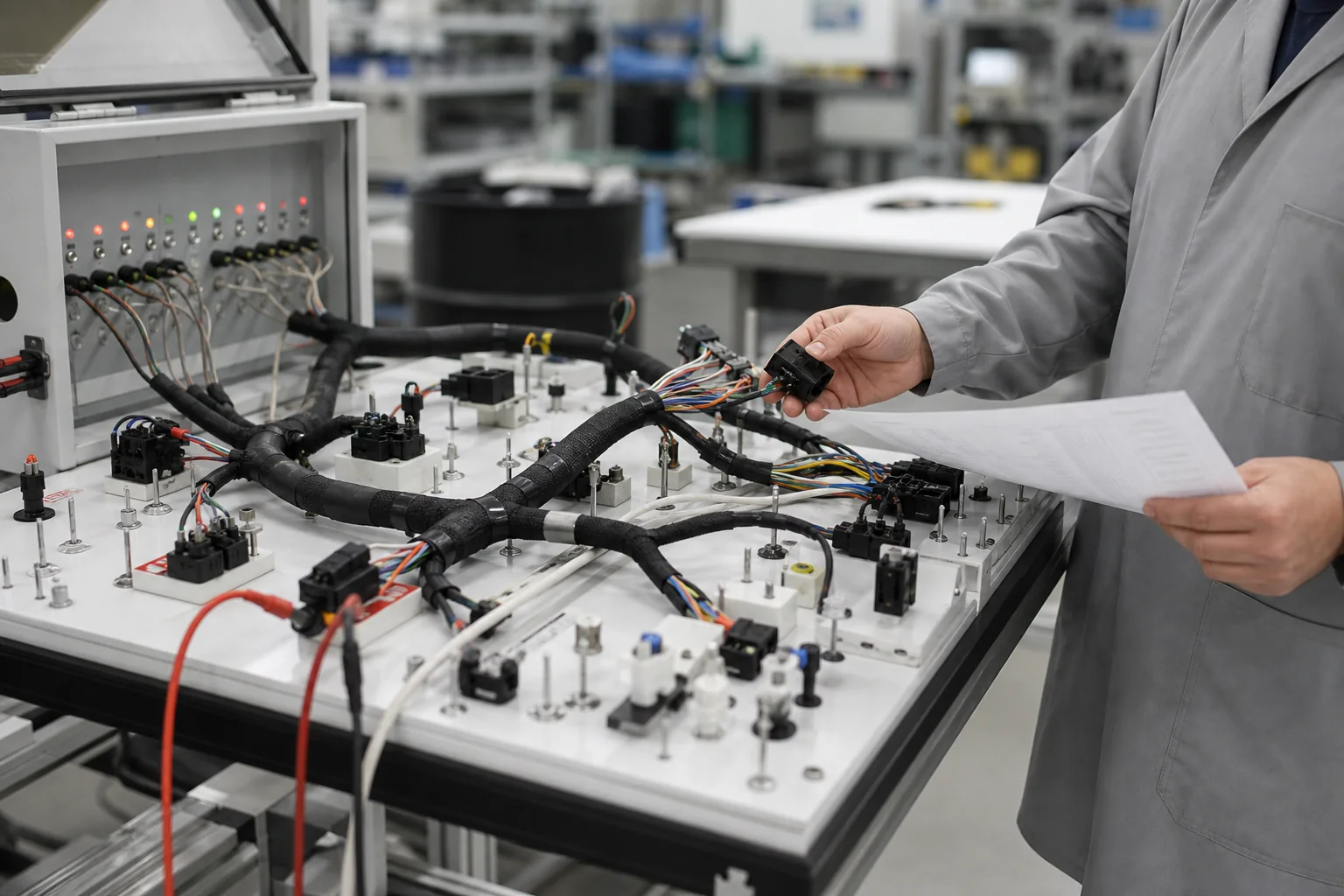
We review the requested test scope before quotation because fixtures, cycle time, sampling plans and reporting can affect both non-recurring charges and unit cost.
5. Include Quantity, Schedule and Delivery Information
Prototype and production quantities require different planning. A small sample run may involve manual setup and material purchases that are distributed across only a few assemblies. Repeat orders may justify dedicated fixtures, material commitments or different packaging.
Please provide:
- Prototype or first-article quantity
- Expected initial production order
- Estimated annual usage and release frequency
- Quantity breaks you want us to quote
- Requested sample and production dates
- Ship-to country or destination
- Bulk, individual, kitted or customer-specific packaging
If the forecast is not fixed, a range is more useful than an unrealistic volume. We can quote several quantities so the project team can see how material purchasing, setup and assembly volume affect the unit price.
What Happens After We Receive Your Wire Harness RFQ?
- Document review: We check the drawing revision, BOM, quantity and required delivery information.
- Technical review: The team reviews pinout, materials, dimensions, assembly processes and test requirements.
- Clarification: We return a focused list of missing information, conflicts or proposed alternatives.
- Material and process costing: We evaluate component sourcing, tooling, assembly operations, inspection and packaging.
- Quotation: The offer identifies the quoted quantity, unit price, non-recurring charges, expected timing, validity and relevant assumptions.
- Sample stage: When required, samples or first articles are built for customer evaluation before repeat production.
This review is intended to align the commercial quotation with the actual product. It is especially important for custom assemblies, where two harnesses with a similar length and wire count can have very different connector, routing, labor and testing requirements.
What If Your Wire Harness Specification Is Incomplete?
You do not need to wait until every detail is final before contacting us. The right quotation depends on the design stage:
| Project stage | What you can send | What we can prepare |
|---|---|---|
| Concept | Application, preliminary schematic, approximate length, wire count and forecast quantity | A feasibility discussion or budgetary estimate with stated assumptions |
| Prototype | Draft drawing, preliminary BOM, pinout and sample quantity | A prototype quotation identifying open materials and one-time work |
| Production transfer | Released drawing, BOM, quality documents, approved sample and production forecast | A production quotation based on a controlled specification |
If you only have an existing part, photographs or hand-marked notes, send what is available and explain what has not yet been decided. We will identify the minimum additional information needed for the next step.
Custom Wire Harness Quote FAQ
Can you quote a wire harness without a complete BOM?
We can often provide a preliminary estimate if the drawing, pinout, application and quantities are available. We will identify assumed materials or missing part numbers. A firm production quotation normally requires an agreed material specification.
Do you support prototype and production quantities?
OUKETECH reviews both prototype and repeat-production requirements. Feasible quantities, material conditions, tooling and timing are confirmed for each project during quotation.
Can you suggest alternative connectors or materials?
Where the customer permits alternatives, we can identify options for review. The quotation should clearly distinguish specified parts from proposed substitutes, and substitutions should be approved before use.
What usually affects custom wire harness pricing?
Major factors can include the specified wire and connectors, material availability, branch count, termination and assembly work, protective covering, labels, testing, documentation, order quantity, packaging and one-time tooling.
Why do you need the annual forecast?
The forecast helps us evaluate material purchasing, production setup, fixtures and suitable quantity breaks. If annual demand is uncertain, provide an expected range and likely release sizes.
Will my drawing and sample be enough for an exact quote?
They may be, but the review can reveal missing component details, conflicting revisions or test requirements that need confirmation. We document those questions rather than assuming a requirement that could change the final price.
Request a Custom Wire Harness Manufacturing Review
Send your drawing, BOM or reference sample together with the prototype quantity, expected production volume, application environment and required delivery location. If the package is incomplete, tell us which decisions are still open.
OUKETECH will review the available information and reply with the technical questions needed to prepare the appropriate quotation. Start your project through our custom wire harness quote request page.