

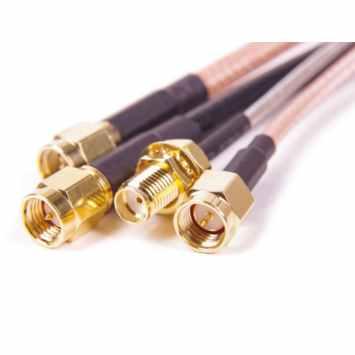
Coaxial cable remains the backbone of reliable RF, video, antenna and signal transmission systems. Whether you are sourcing RG59 coaxial cable for CCTV, low loss coaxial cable for 5G antenna, or custom coaxial cable assembly manufacturer for your project, picking the wrong cable will lead to high signal attenuation, poor VSWR, unstable connection and expensive rework. This guide covers common coax types, connector combinations, key specifications, typical applications and FAQ for engineers, procurement buyers and hobbyists.
1. Popular Coaxial Cable Types & Impedance Options
Two standard impedance classes dominate the market: 50 ohm RF coaxial cable for radio, antenna and wireless systems, and 75 ohm video coaxial cable for CATV, satellite and HD video transmission.
- RG59 coaxial cable for CCTV: The classic 75Ω coax widely used for analog security camera installation. It is flexible and low-cost for short-distance video runs.
- RG6 coaxial cable 75 ohm: Quad shield coaxial cable for CATV and satellite TV, better shielding than RG59 for longer cable routes. RG11 quad shield coaxial cable offers even lower loss for long-distance TV signal distribution.
- RG58 50 ohm coaxial cable: Budget RF coax for ham radio, CB radio and short jumper connections.
- RG174 coaxial pigtail cable: Thin, ultra flexible coax used for internal antenna wiring and compact device pigtails.
- RG316 low loss coaxial cable / RG400 PTFE coaxial cable: PTFE insulated high temperature coaxial cable, stable at high frequency, ideal for GPS, 4G LTE and tight routing.
- RG213 coaxial cable for ham radio: Heavy-duty 50Ω coax for HF/VHF/UHF ham antenna feeds.
- LMR series low-loss coax: LMR195 RF coaxial cable, LMR240 low loss coax and LMR400 coaxial cable are premium low attenuation choices for 4G LTE antenna, 5G router antenna and outdoor wireless links.
- Semi rigid coaxial cable: Used in microwave test equipment and high-precision RF modules.
You will also see copper clad steel CCS coaxial cable and solid copper core coaxial cable. Solid copper delivers better conductivity and lower loss, while CCS is a cost-effective alternative for static, low-power installations.
2. Common Connector Combinations for Coaxial Jumper & Pigtail Assemblies
Most B-side inquiries are for finished jumpers, not bulk cable reels. Matching the connector pair correctly saves huge troubleshooting time.
- SMA male to SMA female coaxial cable, RP-SMA coaxial extension cable: The most popular for WiFi, LoRa and small antenna modules.
- N male to SMA male coaxial cable: Low-loss outdoor antenna jumpers, frequently paired with LMR400.
- BNC to BNC coaxial jumper cable, BNC to RCA coaxial cable: HD SDI coaxial cable for camera, video monitoring and test instruments.
- U.FL IPEX to SMA coaxial pigtail: Tiny internal antenna transition cable inside routers and IoT boards.
- MMCX to SMA right angle coaxial cable: Right-angle coaxial pigtail cable for limited installation space.
- TNC male to N female coaxial cable, PL259 UHF coaxial cable for CB radio: Amateur radio and marine radio connections.
- FAKRA coaxial cable assembly for automotive: Specialized automotive RF cable for vehicle GPS and infotainment.
- MCX coaxial cable assembly: Compact connectors for GPS antenna coaxial pigtail cable.
- CRC9 TS9 coaxial cable for 4G modem: For USB 4G LTE modems.
All these assemblies can be made with gold plated connectors for better corrosion resistance and stable RF contact.
3. Key Features to Compare Before Purchase
Beyond cable model and connectors, check these technical characteristics:
- Shielding: double shield coaxial cable, tri shield coaxial cable and quad shield coaxial cable. More shielding layers reduce EMI and interference.
- Jacket performance: waterproof outdoor coaxial cable, UV resistant coaxial cable, marine waterproof coaxial cable for outdoor, rooftop and boat installation.
- Flexibility: ultra flexible coaxial jumper cable vs semi rigid types. Flexible pigtails suit cabinet routing; semi-rigid suits fixed test circuits.
- Length options: bulk coaxial cable reel 305m for contractors, or pre-terminated coaxial cable in 1m, 2m, 5m, 10m, 15m, 20m lengths. Many buyers look for custom length RF coaxial cable assembly.
4. Main Application Scenarios
- Security: CCTV coaxial cable for security camera, elevator CCTV coaxial cable
- Broadcast & TV: CATV satellite TV coaxial cable, HD SDI coaxial cable for camera
- Wireless communication: coaxial cable for 4G LTE antenna, coaxial cable for 5G router antenna, WiFi antenna extension coaxial cable, LoRa antenna coaxial cable, ADS-B coaxial antenna cable
- Radio hobby: ham radio coaxial antenna cable
- Automotive: automotive FAKRA coaxial cable
- Marine: marine waterproof coaxial cable
5. Custom Coaxial Cable Assembly Service
Many OEM and system integrators search for custom coaxial cable assembly manufacturer. We support low MOQ coaxial jumper cable, custom connector combinations, right-angle terminations, specified jacket colors and testing reports. All pre-terminated coaxial cables are electrically tested before shipment to guarantee VSWR and insertion loss performance.
FAQ
Q: What is the difference between RG6 and RG11 coaxial cable? A: RG6 is thinner and easier to route for standard CATV. RG11 has larger conductor and lower signal loss, used for long-distance cable runs. Both are 75 ohm.
Q: What is 50 ohm coaxial cable used for? A: 50 ohm RF coaxial cable is designed for radio transmission: ham radio, 4G/5G antennas, WiFi, LoRa, GPS and RF test systems. Never mix 50Ω and 75Ω cable in one RF chain, impedance mismatch causes heavy signal reflection.
Q: What is the best low loss coaxial cable for 5G antenna? A: LMR400 delivers excellent low loss for long outdoor antenna runs. For short internal jumpers, RG316 or LMR195 are widely selected.
Q: Can I use RG59 for HD CCTV? A: RG59 works for short-distance analog CCTV. For long-distance HD transmission, RG6 quad shield coaxial cable is recommended.
Final Words
Selecting coaxial cable does not only mean picking RG or LMR numbers. You need to match impedance, frequency range, loss requirement, connector type, working environment and cable length together. If you cannot find standard off-the-shelf jumpers, custom coaxial cable assembly is the reliable solution for your RF project.