

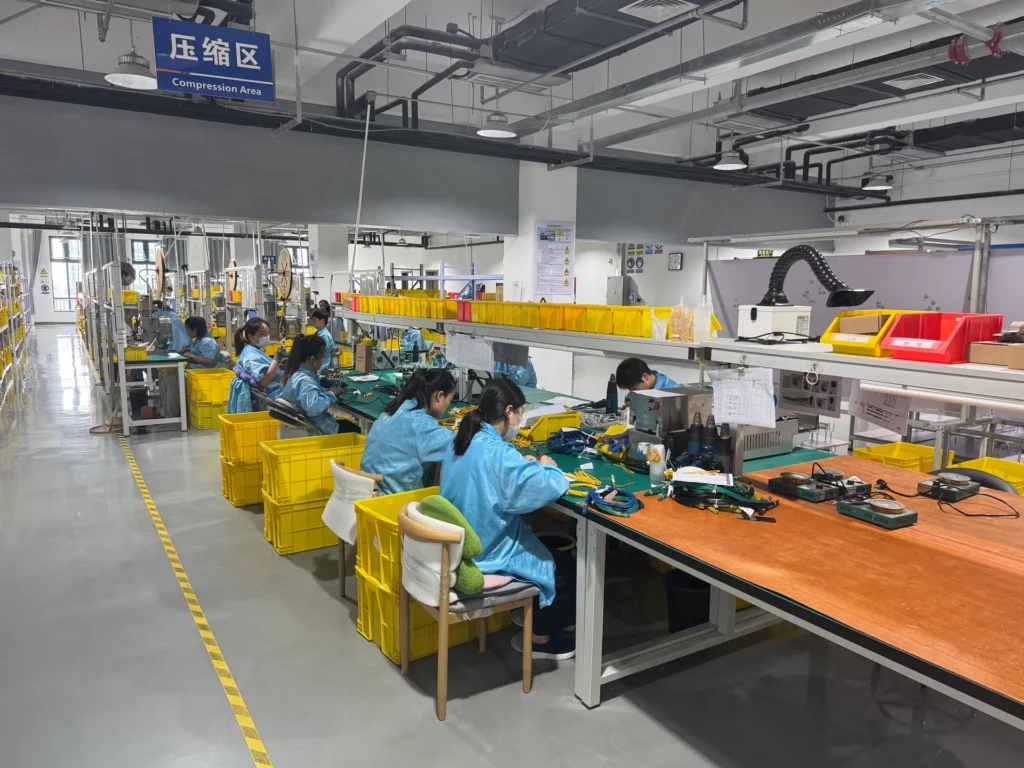
A wiring loom is an organized group of wires or cables routed and secured together to connect electrical components in a machine, vehicle, or other product. A finished loom may include conductors, terminals, connector housings, splices, labels, protective sleeving, conduit, clips, or other features defined by the equipment design. In business-to-business (B2B) sourcing, “loom” and “wire harness” are often used for similar assemblies, so the drawing and bill of materials (BOM)—not the name alone—must define what the supplier builds.
For an original equipment manufacturer (OEM), the practical question is whether the assembly can be installed consistently and perform under the real electrical, mechanical, and environmental conditions. This guide explains wiring loom construction, custom wiring loom fabrication, wire harness assembly, supplier evaluation, and the information to include in a request for quotation (RFQ).
What does a wiring loom do?
A wiring loom organizes electrical paths into a defined assembly so equipment builders do not need to route and terminate every conductor separately during final installation. It carries power or signals between specified connection points while managing wire routing, protection, identification, and fit. The loom’s function depends on its released design; the word “loom” does not define a universal electrical rating or construction.
A loom can simplify equipment assembly because multiple conductors arrive in a planned arrangement with branch lengths, connectors, and protective features already prepared. It can also reduce wiring ambiguity when the assembly has controlled part numbers, connector views, wire identification, and revision status. These benefits depend on a complete design and process controls. A bundled set of wires without verified pinning or dimensional references is not automatically a production-ready assembly.
Wiring looms appear in vehicles, industrial machinery, control panels, appliances, medical equipment, power systems, and other products. Their requirements vary. A stationary internal loom may prioritize compact routing and clear identification, while a machine-mounted assembly may need abrasion protection, strain relief, or defined movement capability. A vehicle application may add vibration, temperature, fluid exposure, and platform-specific requirements.
Is a wiring loom different from a wire harness?
There is no single distinction that applies across every industry and region. “Wiring loom,” “wire loom,” and “wiring harness” can refer to an organized electrical assembly containing wires and associated connection or protection features. Some buyers use “loom” more often for the bundled or protected wire routing, while “harness” may emphasize the complete branched assembly with terminals and connectors. That usage is not a substitute for an agreed specification.
When requesting a quote, describe the physical and electrical configuration rather than expecting a supplier to infer it from the term. Show whether the assembly includes connector housings, terminals, splices, clips, labels, coverings, and breakout branches. State which end views, lengths, and electrical connections control acceptance. If you are still deciding between an individual cable assembly and a branched loom, see OUKETECH’s cable assembly vs. wire harness selection guide.
| Term used in an RFQ | What it may describe | What the buyer should define |
|---|---|---|
| Wiring loom or wire loom | Conductors grouped and routed together, sometimes with protection | Branch layout, coverings, routing dimensions, and terminations included |
| Wire harness or wiring harness | A configured assembly of wires, terminals, connectors, and related features | Circuit connections, connector part numbers, pinout, branches, and acceptance criteria |
| Cable assembly | One or more cables prepared with specified connectors or end terminations | Cable construction, interface, finished length, electrical performance, and protection |
| Sub-loom or sub-harness | A smaller assembly intended to connect into a larger product-level system | Parent assembly interface, identification, revision, and mating details |
These descriptions are practical sourcing aids, not formal definitions. OUKETECH’s custom wiring harness page describes custom harness manufacturing for OEMs and contract manufacturers. Project scope should still be confirmed against the specific drawing and quotation.
What components can a custom wiring loom include?
A custom wiring loom can combine conductors, terminations, interfaces, protection, and mounting features selected for a particular product. Each element should match the released design and operating conditions. Buyers should avoid specifying a material or feature by name alone when its rating, dimensions, compatibility, or installation role affects performance.
| Component or feature | Role in the assembly | Information to confirm |
|---|---|---|
| Wire or cable | Carries electrical power or signals | Part number or construction, conductor size, insulation, color, length, and application limits |
| Terminal or contact | Makes the electrical termination | Exact part number, wire range, plating where specified, approved tooling/process, and insertion orientation |
| Connector housing | Provides a mating interface and circuit positions | Manufacturer and part number, keying, cavity map, seals, locks, and mating connector |
| Splice or junction | Joins conductors at a defined circuit point | Circuit map, joining method, location, insulation, and inspection requirements |
| Sleeve, tape, conduit, or braid | Protects or groups the routed assembly | Material, coverage, overlap, cut ends, environmental exposure, and installation envelope |
| Clip, bracket, or grommet | Supports or routes the loom in the equipment | Part number, location, orientation, retention, and mating panel or feature |
| Label or marker | Identifies circuits, branches, or assembly revision | Text, location, durability, legibility, and traceability expectations |
The component list is not a universal bill of materials. An OEM engineer should approve materials and interfaces for the actual current, voltage, signal, temperature, motion, vibration, fluids, and installation conditions. Where a proposed alternate is considered, require a documented review and approval before it enters production.
How does wiring loom fabrication work?
Wiring harness fabrication turns the released engineering definition into a repeatable assembly. The exact operations depend on the loom design, terminals, connector system, protective coverings, and quality plan. Buyers should ask a prospective supplier how it will control the steps that matter to their particular assembly, instead of assuming every wiring loom manufacturer uses the same process or equipment.
A typical manufacturing sequence may include:
- Review the design package. Confirm drawing revision, BOM, connector views, pinout, length references, material requirements, and open questions. Resolve ambiguities before cutting wire.
- Prepare conductors. Cut and strip wires to the defined lengths and stripping requirements. Apply wire identification when specified.
- Terminate conductors. Crimp or otherwise terminate conductors using the approved terminal and applicable process requirements. An acceptable appearance alone does not prove that a termination meets the agreed criteria.
- Load connectors and build branches. Insert contacts into the correct cavities, complete specified splices, and route the loom on an assembly board or other controlled fixture where appropriate.
- Apply protection and hardware. Install sleeve, tape, conduit, clips, grommets, labels, or other features according to the drawing and work instructions.
- Inspect and test. Perform the checks stated in the quality plan, such as visual or dimensional inspection and electrical tests with defined coverage and acceptance limits.
- Release and pack. Confirm identification, revision, required records, packaging, and shipment quantities against the order.
For workmanship expectations, the contract may invoke an applicable revision and class of IPC/WHMA-A-620. IPC describes the standard as covering materials, methods, tests, and acceptability criteria for cable and wire harness assemblies. It does not replace the product drawing, electrical design requirements, or buyer-specific acceptance plan. State the applicable revision and class in the purchasing documents, and verify which obligations apply to the program. See OUKETECH’s IPC/WHMA-A-620 guide for additional purchasing context.
Which design details affect fit and performance?
The most important loom details are the ones that control electrical function, mechanical fit, and repeatable installation. A supplier cannot reliably resolve missing requirements by guessing what the finished assembly should do. The engineering team should identify application conditions and specify measurable acceptance criteria where they affect safety, function, or quality.
Electrical and connection definition
Document each circuit’s source and destination, connector identification, cavity or pin number, wire specification, and any intentional joins or shield connections. Provide a connection table or schematic that agrees with the connector views. Confirm whether connector diagrams are shown from the mating face, wire-entry face, or another stated orientation. Ambiguous views are a common way for two parties to interpret the same pinout differently.
For power circuits, define the expected electrical load and relevant voltage-drop or temperature requirements through the responsible design authority. For signal circuits, state interface-specific requirements such as shielding, twist, impedance, or signal-integrity verification when applicable. Do not assume that wire color or conductor count alone defines a circuit.
Geometry and installation
Define overall and branch lengths, measurement points, breakout locations, connector orientation, and any critical routing envelope. Identify whether lengths are measured between connector faces, cable exits, terminal ends, or another datum. Include tolerances where they matter to installation. A loom that passes an electrical check may still fail to fit if its branch lengths or connector clocking are wrong.
Show clips, grommets, and mounting points in relation to product interfaces. State whether a feature is customer-supplied or included in the quoted assembly. For moving applications, describe the motion profile and expected service life with engineering-defined criteria; “flexible” alone is too vague to select and validate a construction.
Materials and environment
Specify the required temperature range, moisture or fluid exposure, abrasion, vibration, cleaning agents, ultraviolet exposure, and other conditions relevant to the installed location. Separate continuous operating conditions from occasional events such as cleaning or servicing. Identify the required materials, ratings, and compliance evidence, and have engineering approve any alternatives.
Protection should match the actual failure risk. A conduit can help manage abrasion or routing, but may affect space and bend behavior. A label can support service identification, but its position and durability must fit the environment. Shielding can address electromagnetic coupling, but the termination and grounding design must also be defined. More layers or features do not automatically improve a design.
What should OEM buyers include in a wiring loom RFQ?
A useful RFQ gives each supplier the same technical and commercial basis for quotation. Include controlled design inputs, quantity assumptions, required validation, and delivery terms. If a detail is unresolved, mark it as an open item and ask the supplier to state its assumption so engineering and procurement can review the same question.
| RFQ item | Include | Why it matters |
|---|---|---|
| Drawing and revision | Assembly layout, dimensions, branch locations, connector views, and revision identifier | Prevents suppliers from quoting different configurations |
| BOM | Wire, terminals, housings, seals, splices, protection, clips, and approved alternates | Clarifies sourcing scope and substitution control |
| Connection data | Schematic, pinout table, cavity numbering, and shield or splice details | Reduces wiring interpretation errors |
| Application conditions | Electrical load or signal needs, temperature, motion, vibration, fluids, and routing | Supports material and process review |
| Quality plan | Applicable workmanship standard and revision, inspections, tests, limits, records, and sampling | Defines acceptance instead of relying on an undefined “tested” claim |
| Quantities and schedule | Prototype quantity, initial lot, forecast, release pattern, and required delivery date | Makes price and capacity assumptions comparable |
| Commercial terms | Packaging, shipping destination, Incoterm, tooling/NRE, payment, and quote validity | Helps purchasing compare landed and program costs |
| Approval and change control | Sample review, deviation authority, alternate approval, and revision release | Prevents unapproved changes becoming the production baseline |
For further preparation, review OUKETECH’s custom cable assembly manufacturing page. The exact inputs differ by design, and the RFQ should identify product-specific requirements rather than copy a generic checklist unchanged.
How should buyers evaluate a wiring loom manufacturer?
Evaluate the supplier against the needs of the assembly and the evidence required by your organization. Ask how engineering clarifications, material substitutions, revisions, termination processes, inspections, and nonconformances are controlled. A capability statement can help identify fit, but a project-specific review shows whether the supplier understands your actual design and commercial assumptions.
| Evaluation topic | Questions to ask | Useful evidence to request when applicable |
|---|---|---|
| Engineering review | How are incomplete drawings, connector views, or length definitions clarified? | Written DFM questions, reviewed drawing, or assumptions list |
| Material control | How are exact part numbers and approved alternates managed? | BOM review and documented deviation process |
| Termination workmanship | What process and acceptance requirements apply to the specified terminal? | Defined inspection criteria or records required by the program |
| Electrical test | What circuits and fault conditions does the test cover? | Test coverage, limits, and agreed report format |
| Production repeatability | How are revisions, work instructions, and released samples controlled? | Revision records and sample-release process |
| Supply and schedule | Which components have long lead times or minimum buy quantities? | Sourcing assumptions, lead-time basis, and quantity tiers |
Do not assume that a quotation includes every validation activity, report, fixture, or traceability record. Ask the supplier to itemize one-time costs and state what is included in unit pricing. OUKETECH’s live custom wiring harness manufacturing page describes its offered manufacturing services; confirm project-specific scope, equipment, test coverage, capacity, certifications, and commercial terms directly during procurement review.
FAQ: Wiring looms for OEM and B2B projects
Is a wiring loom the same as a wiring harness?
The terms often overlap, but usage varies by industry and buyer. Both can describe organized conductors with terminations and protective features. Define the actual components, circuit map, branches, dimensions, and acceptance criteria in the drawing and BOM.
What is custom wiring loom fabrication?
Custom wiring loom fabrication is the production of an assembly to an application-specific design. It can include conductor preparation, termination, connector loading, branch routing, protective coverings, mounting hardware, inspection, and testing as specified for the project.
What information does a supplier need to quote a custom wiring loom?
Provide the drawing revision, BOM, schematic or pinout, connector part numbers, wire requirements, quantities, application environment, inspection and test requirements, and delivery assumptions. Identify open decisions so suppliers do not make incompatible assumptions.
Does every wire harness assembly need the same tests?
No. The test plan should match the design risks, customer requirements, and applicable contract documents. Define the electrical coverage, acceptance limits, sampling, and records required. A generic statement such as “100% tested” is not meaningful unless the tests and limits are clear.
Can a wiring loom design change after prototype approval?
It can, but changes should be reviewed, documented, and released through the agreed change-control process. Changes to wire, terminals, connector cavities, branch dimensions, protection, or test requirements may affect fit, function, cost, validation, and schedule. Do not assume that a sample approval authorizes undocumented substitutions.
Prepare your custom wiring loom project for quotation
A custom wiring loom is best sourced as a controlled assembly with a clear electrical definition, installation geometry, approved materials, and an agreed quality plan. The term “loom” tells a supplier the general product family; the drawing, BOM, and acceptance criteria define the actual build.
For a quotation review, send OUKETECH your current drawing, BOM, schematic or pinout, connector and terminal part numbers, prototype and production quantities, application conditions, and required inspections or test records. Use the OUKETECH contact page to start the discussion. Confirm project-specific feasibility, materials, lead time, MOQ, validation, and any compliance requirements before approving production.