

Buying a custom wire harness to IPC/WHMA-A-620 starts with a clear acceptance requirement. This standard addresses assembly workmanship, but your purchase also needs a defined drawing revision, component list, inspection plan, and delivery expectations. Without those details, two apparently comparable quotations can cover very different work.
OUKETECH supplies custom wire harnesses and cable assemblies for OEM projects. If your drawing references IPC/WHMA-A-620, send that requirement with your request for quotation (RFQ). Ask us to confirm the applicable revision, product class, documentation, and project fit before you commit to samples or a production order.
The goal is straightforward: give your purchasing and engineering teams an agreed basis for evaluating the sample, comparing the quote, and accepting the shipment. The inspection setting below illustrates that relationship between the assembly and its documentation.
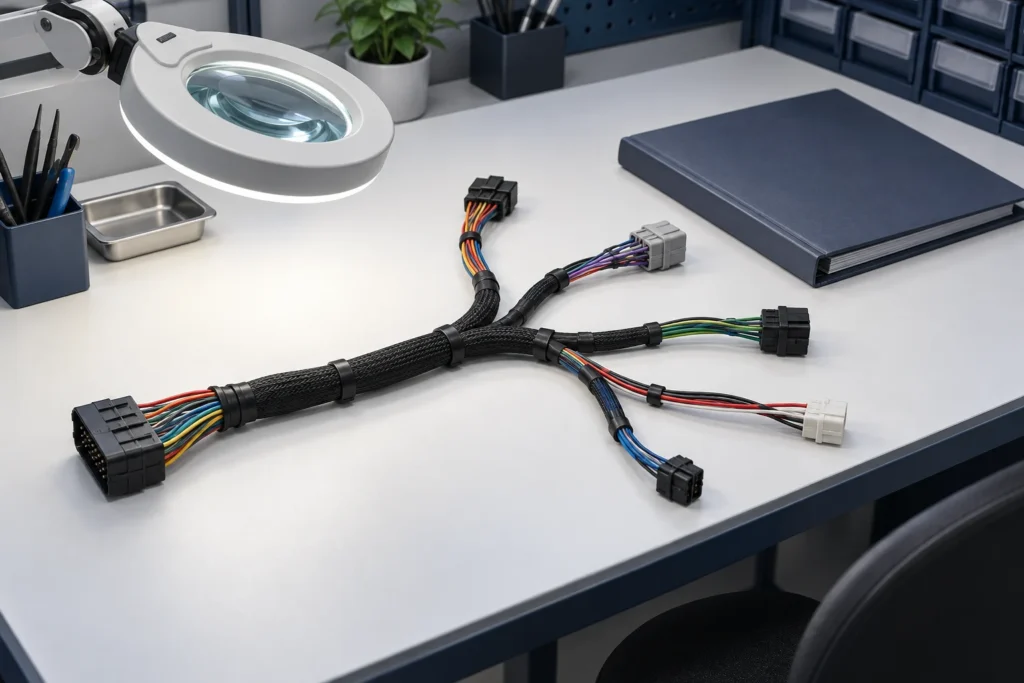
Already have a drawing and bill of materials? Send your wire harness RFQ to OUKETECH with the required standard revision, class, and quantities.
What IPC/WHMA-A-620 Means for Your Purchase
IPC/WHMA-A-620 establishes requirements and acceptance criteria for cable and wire harness assembly, including crimped, soldered, and mechanically secured connections. For procurement, its value is a shared workmanship reference. Product-specific instructions still need to identify what you are buying and how your supplier should demonstrate acceptance.
The official public preview identifies IPC/WHMA-A-620F, October 2025. It also states that a newer revision is not automatically required; the user specifies the applicable revision. Reference the agreed edition explicitly instead of leaving the purchase order at “latest IPC.” See the official IPC/WHMA-A-620F overview and preview.
Consider a repeat order that previously used Revision E. Automatically changing the purchase order to F creates a question your quotation may not address: has the supplier reviewed the revised requirements against this particular assembly? Ask for that review before changing an established production baseline.
When sourcing IPC/WHMA-A-620 compliant wire harness assemblies, request a written response against your requirements. A standard number on a website is a starting point for discussion. Your order needs agreement on the actual product and the evidence delivered with it.
For projects combining multiple cables, connector interfaces, or protective coverings, explore OUKETECH’s custom cable assembly services and include the relevant acceptance notes in your inquiry.
IPC-A-620 Class 2 vs Class 3: What Should Buyers Specify?
Select the class with your engineering team according to the product’s service requirements. Do not choose solely by industry label, unit price, or the assumption that a higher number automatically makes the design suitable. Tell the supplier which class applies before requesting comparable quotations, and record that choice in the purchasing documents.
| Product class | Brief description | Procurement decision to resolve |
|---|---|---|
| Class 1 | Function is the principal requirement. | Has engineering approved this level for the assembly? |
| Class 2 | Extended service is expected; uninterrupted operation is desirable but not critical. | What service conditions and acceptance evidence must the quote cover? |
| Class 3 | Required operation is critical; downtime is unacceptable or conditions may be harsh. | Which additional project specifications must accompany the class? |
These are abbreviated descriptions, not inspection criteria. The user is responsible for identifying the class; consult the official classification section and the contractually applicable standard.
A buyer searching for a Class 3 wire harness assembly supplier should also explain the environment, interfaces, service life, and required records. An acceptance class does not fill in a missing pinout, select an appropriate connector, or define every qualification test for the finished equipment.
For an industrial control assembly, describe whether the harness stays inside a cabinet, crosses a moving joint, or connects to exposed equipment. Those are different purchasing situations. OUKETECH’s industrial wire harness page provides a relevant starting point for discussing your application.
Wire Harness Quality Requirements to Put in Your RFQ
A useful wire harness quality inspection checklist connects each purchasing concern to a document or verification activity. Ask what evidence you will receive, who approves it, and which drawing revision it represents. This makes the quotation easier to evaluate and gives receiving inspection a practical basis for releasing or holding the shipment.
The following is a recommended buyer checklist, not a reproduction of IPC acceptance criteria.
| Purchasing concern | Information to specify | Evidence to discuss before ordering |
|---|---|---|
| Incorrect components | Wire, terminal, housing, seal, and accessory part numbers; approved alternatives | Bill of materials review and agreed component identification records |
| Inconsistent terminations | Applicable terminal application specification and acceptance documents | Tooling identification and relevant crimp inspection or test records |
| Wrong pinning, opens, or shorts | Connector views, cavity numbering, and connection table | Test coverage against the released pinout |
| Poor mechanical fit | Branch lengths, measurement datums, breakout positions, and orientation | Sample dimensional results and installation feedback |
| Insulation or covering concerns | Material specification, protection, and applicable test requirements | Agreed visual checks and electrical test documentation |
| Uncontrolled changes | Drawing revision, substitution rules, and approval authority | Written deviation approval and revision-linked order records |
| Shipment identification | Label content, batch identification, and packaging requirements | Agreed labeling and delivery documentation |
Treat a missing requirement as an open commercial issue. If one quote includes serialized results and another includes only a shipment declaration, their prices do not describe the same delivery scope.
For an OEM wire harness manufacturer quotation, separate mandatory requirements from preferences. Mark which connector alternatives are allowed, which dimensions affect installation, and which records your quality team needs. This gives the supplier room to discuss cost without silently changing an essential requirement.
Crimp Quality: Ask for the Applicable Specification
Do not copy a crimp height or pull-force value from an unrelated harness. Ask which terminal, wire combination, and tooling specification govern the connection. Molex explains where buyers and engineers can find crimp height, pull force, and strip length information in its application tooling guidance.
For a wire harness crimp pull test report, agree on the sample identification, method, acceptance reference, and reporting format. Ask how the sample relates to the production setup. A result without that context is difficult to use when investigating a later lot.
If your specification requires destructive testing, identify the test samples separately from the deliverable assemblies. Include sample quantities and their cost in the quotation request. The test plan should be practical for both prototype purchasing and recurring production.
Fit and Identification: Small Details That Affect Receiving
A photograph rarely resolves connector orientation or measurement datums. Supply a drawing view that defines where a branch length begins and ends. If the connector can be installed in more than one orientation, show the required orientation and mating interface.
Specify label content and placement before sample approval. An electrically correct harness can still create installation delays if technicians cannot identify its branches. Request packaging that preserves the agreed presentation and keeps order identification associated with the parts.
Testing and Inspection: Define What the Shipment Must Prove
Replace “fully tested” with an agreed list of checks, acceptance references, coverage, and records. Visual inspection, connection verification, and insulation testing answer different questions. Your purchasing team should know which checks are included in the quote and which require application-specific engineering review before they can be specified.
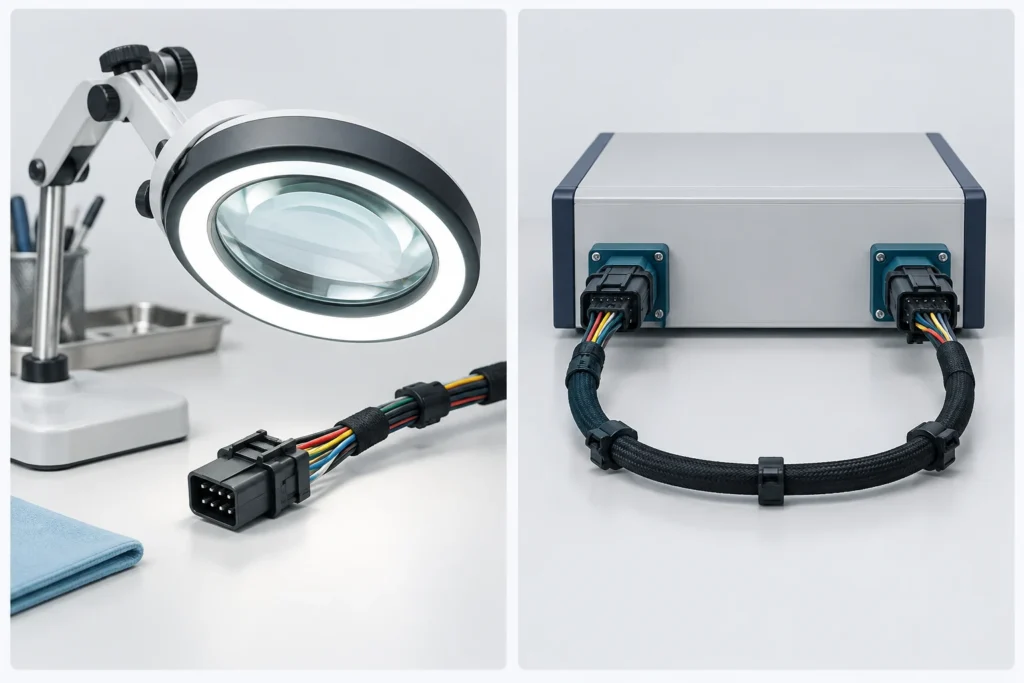
For wire harness continuity and short-circuit testing, start with an approved connection table. Ask whether the proposed test verifies both intended connections and unintended connections. Identify any components inside the harness that affect the expected readings or require a different test approach.
Where insulation resistance or dielectric withstand testing is applicable, ask engineering to define the conditions and compatibility with the assembly. Do not prescribe an arbitrary voltage as a purchasing shortcut. Cirris explains why component-containing cables require careful test programming in its high-voltage testing guidance.
The A-620F public scope does not set in-process or end-product inspection frequency. Agree the inspection plan separately rather than interpreting the standard reference as a universal sampling plan. The official scope statement makes this distinction explicit.
Ask these questions when requesting a custom cable assembly with test reports:
- Which checks apply to every delivered assembly, and which apply to agreed samples?
- Which approved documents define the acceptance limits?
- How are results associated with the order, lot, or serial number?
- What happens after a failed check, rework, or a test-program change?
- Which reports accompany shipment, and which remain available on request?
These are proposed purchasing questions. The answers should become part of your agreed order scope, including any extra fixture, reporting, or sample costs.
How to Evaluate an IPC-A-620 Wire Harness Supplier
Evaluate the people, manufacturing scope, and order evidence separately. Training credentials help you assess familiarity with a standard. A facility qualification addresses a different question. Your shipment still needs documentation tied to its requirements. Combining these into one “IPC certified” checkbox makes supplier comparisons less useful.
IPC’s A-620 training and endorsement program covers individual certification pathways such as Certified IPC Specialist and Certified IPC Trainer. Ask which personnel and relevant modules the credentials cover, and check their current validity.
Manufacturer qualification is distinct. IPC has also operated a Qualified Manufacturers Listing program, described in its official explanation of A-620 QML qualification. If a supplier claims that status, verify the current facility, scope, and validity rather than relying on an old announcement.
| Supplier statement | Follow-up question | Useful purchasing evidence |
|---|---|---|
| “Our staff are IPC certified.” | Which staff, program, modules, and validity period? | Relevant current credentials and responsibility assignments |
| “We manufacture to A-620.” | Which edition and class apply to this order? | Written review of your drawing and acceptance requirements |
| “Our facility is qualified.” | Which site and manufacturing scope does that cover? | Current applicable qualification evidence |
| “The shipment is compliant.” | Which part, revision, quantity, and requirements does the statement cover? | Agreed declaration and supporting order records |
Use the same questions when evaluating OUKETECH. Send your supplier qualification checklist with your RFQ and identify any credentials that are mandatory. Ask us to confirm the project scope and supporting documentation before you place the order.
A clear answer that identifies an exception is more useful than an unconditional yes. Resolve exceptions before sample production so that purchasing, engineering, and quality approve the same requirement set.
A Practical Wire Harness RFQ Checklist for OEM Buyers
Your RFQ should let the supplier identify the assembly, understand acceptance, and price the requested delivery. Send the drawing and bill of materials together with the quality notes. For OUKETECH inquiries, include the production stage and quantities so the conversation addresses your actual purchasing schedule as well as the technical assembly.
The illustration below shows the relationship between a sample, component information, and the documents needed for a sourcing discussion.
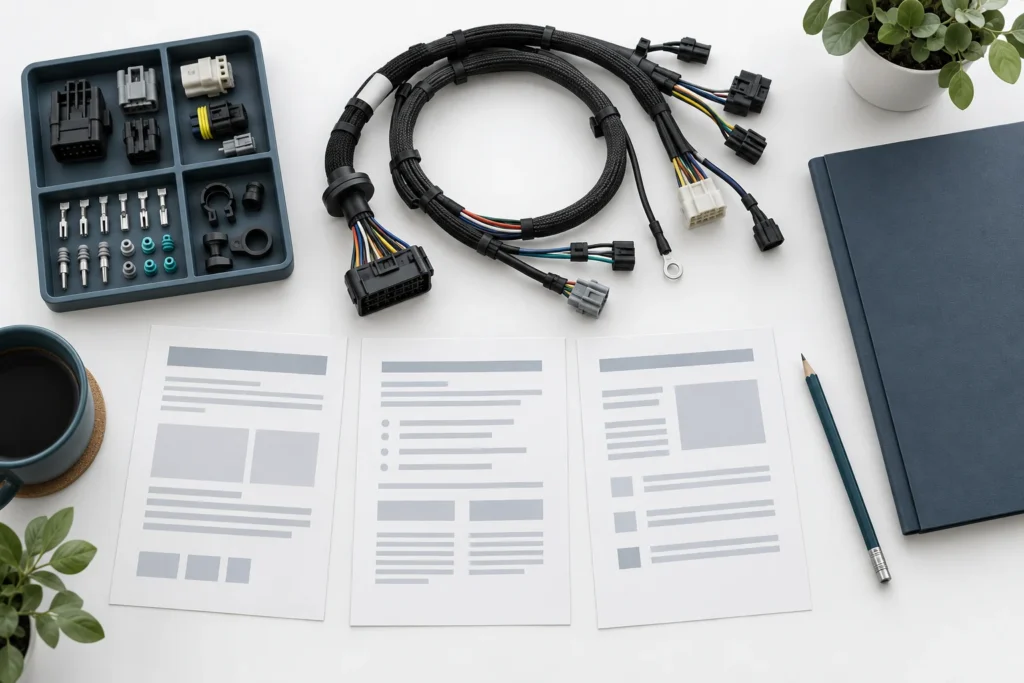
Include:
- Product identity: part number, drawing revision, bill of materials (BOM), and intended application.
- Acceptance baseline: IPC/WHMA-A-620 revision, class, and any applicable additional specifications.
- Connection details: terminal and connector part numbers, wire specifications, pinout, and mating views.
- Mechanical details: overall and branch lengths, datums, coverings, breakout positions, and labels.
- Verification: inspection scope, test references, coverage, sample requirements, and required reports.
- Commercial quantities: prototype quantity, initial production lot, release quantities, and estimated annual demand.
- Approval and delivery: sample approval process, requested delivery date, packaging, and change authorization.
Suggested RFQ Wording
Adapt this example with your engineering and quality teams before issuing it:
Please quote the attached wire harness drawing and BOM at the stated revisions. Our acceptance requirement is IPC/WHMA-A-620, with the applicable revision and product class identified in the attached quality specification. Please confirm acceptance of that requirement or list exceptions. Itemize sample costs, production price breaks, tooling or test-fixture charges, material assumptions, inspection and test coverage, shipment documentation, and lead time. Identify proposed substitutions and deviations for written approval before manufacture.
This is a purchasing brief, not a replacement for the standard or your controlled specifications. It makes unanswered questions visible while the quote is still being developed.
If the class or edition remains undecided, mark it as an open engineering item. Request any initial pricing on explicitly stated assumptions, then close those assumptions before releasing the production order.
Compare MOQ, Lead Time, and Production Cost on the Same Basis
A useful wire harness assembly quotation separates recurring unit cost from setup, samples, fixtures, and documentation. Request prices for your expected release quantities, not only annual demand. A large annual forecast does not mean all components will be purchased or all assemblies delivered in one economical batch.
| Quote element | What to ask OUKETECH or another supplier | Why it matters |
|---|---|---|
| Minimum order quantity (MOQ) | Is the minimum driven by assembly, material purchase, or packaging? | Identifies the actual small-order constraint |
| Prototype and sample charges | What quantity, review scope, and records are included? | Makes sample approval costs visible |
| Tooling and fixtures | Which charges are one-time, and who owns the tooling? | Clarifies future repeat-order costs |
| Production unit price | Which release quantity and material assumptions apply? | Prevents comparison of different purchasing scenarios |
| Lead time | When does the quoted clock start, and what must be approved first? | Separates purchasing expectations from unresolved inputs |
| Documentation | Which inspection and traceability records are included? | Aligns price with your receiving requirements |
For prototype wire harness assembly, prioritize resolving the drawing and fit questions. For small-batch purchasing, identify setup and component minimums. For high-mix orders, make each variant and revision explicit. For high-volume production, discuss release schedules, approved changes, and repeat-order consistency.
Do not assume Class 3 creates a fixed percentage surcharge. Ask which requirements change the proposed work, verification, or documentation for your assembly. Compare those line items instead of applying a generic “higher class” premium.
Bring Your Wire Harness Project to OUKETECH
OUKETECH is a sourcing option for buyers seeking custom wire harnesses and cable assemblies. Bring us the application, drawings, quantities, and acceptance requirements together. That gives your inquiry a clear commercial purpose: establish project fit, identify unanswered questions, and request a quotation against a defined scope.
Start with the documents you already control. Include prototype, small-batch, high-mix, or high-volume requirements as applicable. State whether you are developing a new assembly, transferring an existing part, or preparing a repeat purchasing program.
Before ordering, ask for written confirmation of the proposed materials, applicable acceptance requirements, test scope, documentation, and delivery assumptions. Review any exceptions with your engineering team. The objective is a purchase you can approve and a shipment your receiving team knows how to evaluate.
Request a custom wire harness quotation from OUKETECH. Send your drawing, BOM, required IPC/WHMA-A-620 revision and class, sample quantity, annual demand, and test-report requirements
FAQ: IPC/WHMA-A-620 for Wire Harness Procurement
Can I request IPC/WHMA-A-620 compliance without specifying a class?
Resolve the class with engineering and document it before order release. Leaving it open makes the acceptance basis ambiguous. Ask your supplier to flag any missing requirement while preparing the quotation.
Does an IPC-certified employee mean every harness is compliant?
No. An individual credential and product acceptance are different matters. Ask for the applicable credentials and the agreed evidence supporting your order. Neither a certificate image nor a general website claim defines your shipment’s acceptance scope.
Should I always specify the newest A-620 revision?
Use the edition approved for your project. For a revision change, ask engineering and the supplier to review its effect on the assembly and purchasing documents before implementing it.
Does a continuity test prove the whole harness meets my requirements?
No. Your acceptance plan may also need dimensional, visual, mechanical, insulation, or other application-specific checks. Request explicit test coverage rather than relying on the phrase “electrically tested.”
Can OUKETECH quote my Class 2 or Class 3 wire harness project?
Send the drawing, BOM, class, revision, quantities, and required qualification evidence. Ask OUKETECH to confirm suitability and any exceptions for your particular project before you approve samples or production.
What should I send if I only have a sample harness?
Explain the application and provide available photographs, dimensions, connector identification, and quantity expectations. Ask what additional documentation is needed for a quote. Agree responsibility for creating and approving a controlled drawing before treating the sample as a production specification.