

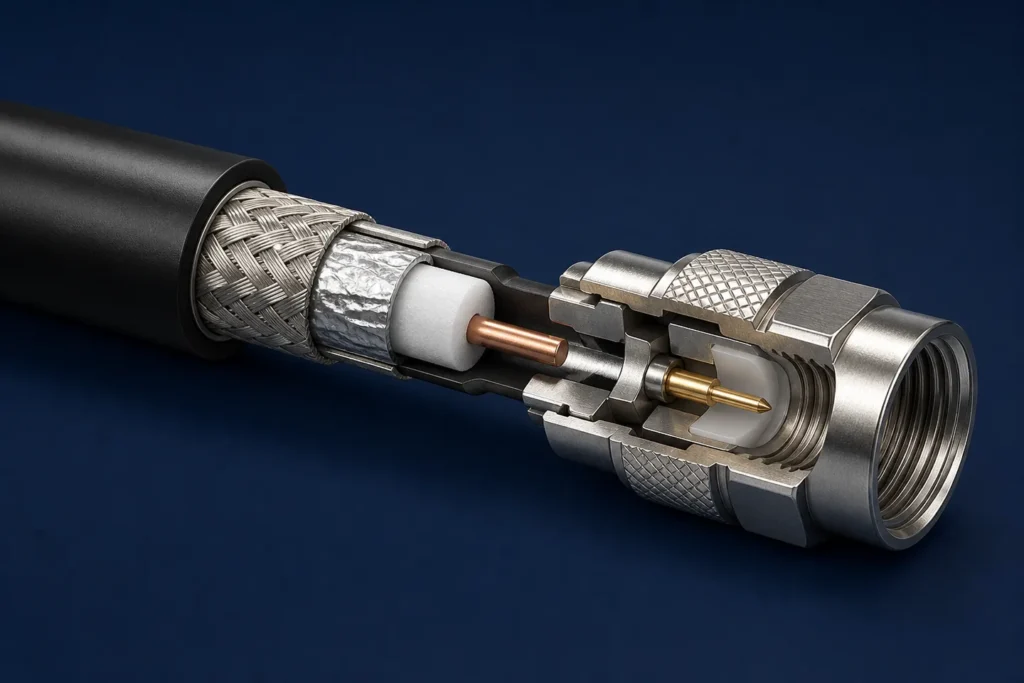
In applications involving RF testers, spectrum analyzers, signal generators, impedance testing equipment, and high-frequency precision inspection systems, issues such as impedance discontinuities, signal reflections, data drift, and excessive high-frequency attenuation in coaxial cable assemblies represent the most common—and hardest to troubleshoot—hidden faults encountered during R&D and testing. Most general-purpose coaxial cable assemblies are designed merely for basic signal transmission; lacking impedance calibration and signal optimization tailored to the rigorous demands of high-frequency, precision RF testing, they are prone to problems like excessive VSWR, signal distortion, and poor repeatability. These issues directly compromise measurement accuracy, leading to erroneous test results, delays in R&D and debugging, and failures in mass-production quality control.
The essence of RF testing lies in achieving end-to-end impedance matching and lossless signal transmission. As the core medium of the transmission link, the cable assembly determines the outcome; if its specifications, manufacturing processes, or termination and tuning fall short, accurate test data cannot be obtained—even if the main testing instrument itself meets precision standards. To address the stringent requirements for high-frequency, precision, and low-loss performance in RF testing equipment, we specialize in the custom design of RF coaxial cable assemblies. We offer comprehensive solutions featuring end-to-end impedance matching design and professional signal tuning and calibration services, effectively resolving industry pain points such as high-frequency signal attenuation, reflection interference, and data drift to ensure the stable operation of various mid-to-high-end RF testing systems.
一、 RF Testing Equipment: Root Causes of Impedance Mismatches in Coaxial Cable Assemblies
Unlike standard industrial transmission cables, RF coaxial cable assemblies demand extremely high precision regarding impedance, structural consistency, shielding performance, and termination processes. Using general-purpose cables with RF testing equipment inevitably leads to various malfunctions; the core reasons—which represent common pitfalls in the industry—are as follows:
- Inconsistent impedance parameters causing signal reflection: Mainstream RF testing equipment operates on either 50Ω or 75Ω impedance systems (with 50Ω common in semiconductor high-frequency testing and RF instrumentation, and 75Ω common in audio-video RF testing). General-purpose cables often feature loose impedance tolerances and inconsistencies across connectors, cabling, and adapters. This creates impedance discontinuities throughout the test link, causing severe signal reflection during high-frequency transmission, which results in excessive Standing Wave Ratios (SWR) and sharp increases in signal loss.
- Structural deviations compromising impedance continuity: Impedance stability is directly determined by the coaxial cable’s conductor diameter, dielectric layer thickness, and shielding density. Standard mass-produced cables often suffer from manufacturing defects such as conductor eccentricity, uneven dielectric thickness, and sparse shielding. These issues lead to significant impedance fluctuations over transmission distances and intermittent signal drift under high-frequency conditions, resulting in unstable test data and poor repeatability.
- Poor termination quality causing abrupt impedance changes: Improper soldering or crimping when attaching RF connectors (such as SMA, BNC, N-type, or 2.92mm) leads to issues like solder buildup, core wire misalignment, shielding burrs, and crimping gaps. These defects cause sudden changes in port impedance, serving as primary triggers for high-frequency signal attenuation and spurious interference, as well as the root cause of most testing errors.
- Insufficient shielding performance and susceptibility to external interference and crosstalk: RF detection typically involves weak, high-frequency signals. Standard single-layer shielded wiring harnesses offer poor interference resistance; electromagnetic equipment, power supplies, and line crosstalk in the workshop can easily infiltrate the signal path, causing elevated noise floors and signal distortion, thereby failing to meet the signal-to-noise ratio requirements for precision testing.
二、 Custom RF Coaxial Cable Assemblies: End-to-End Impedance Matching Solutions
To meet the precision transmission requirements of RF testing equipment, OUKETECH moves beyond standard cable manufacturing norms. We offer fully customized solutions—covering cable selection, structural design, impedance calibration, termination processes, and shielding optimization—to achieve 100% impedance matching across the entire test link. This minimizes signal loss and reflection, ensuring accurate and stable test data.
- Precision Impedance Selection and Unified Link Standards
We select components on a one-to-one basis according to the client’s RF testing equipment frequency bands, interface parameters, and testing scenarios. We strictly distinguish between 50Ω high-frequency testing systems and 75Ω RF transmission systems, ensuring no mixing of impedance standards. Cables are matched to specific frequency requirements: RG316 and RG58 for standard low-frequency testing, and RG223 or low-loss PTFE RF cables for high-frequency precision testing and low-loss applications. By locking in the baseline impedance value at the source, we eliminate link impedance mismatch issues. - Precision Structural Control to Ensure Impedance Continuity
We strictly control the precision of the coaxial structure throughout the custom manufacturing process. This ensures the inner conductor is perfectly centered, the foamed or solid dielectric layer has uniform thickness, and the dual-layer shielding fits tightly, keeping impedance fluctuations within extremely tight tolerances. We eliminate the localized impedance shifts common in standard cable assemblies, guaranteeing continuous impedance from port to cable body. This ensures seamless high-frequency transmission without discontinuities or abrupt changes, maintaining stable Voltage Standing Wave Ratio (VSWR) parameters within specifications. - Refined Termination Processes to Correct Port Impedance Defects
For port areas—where high-frequency faults frequently occur—we employ specialized RF precision processing techniques: precise control of stripping dimensions to eliminate burrs on the dielectric and shielding layers; standardized constant-temperature soldering with precise solder volume control to prevent cold joints or excess solder buildup; and coaxial alignment during connector installation to eliminate misalignment or tilting. Precision termination eliminates port impedance discontinuities and significantly reduces signal loss, meeting the requirements for high-frequency precision testing. - Multi-layer shielding structure for high-frequency signal integrity
The precision RF test harness employs a fully covered structure featuring dual-layer braided shielding and aluminum foil wrapping. With a shielding coverage exceeding 98%, it effectively isolates external electromagnetic interference and RF crosstalk, lowers the noise floor, and improves the signal-to-noise ratio. This eliminates test data fluctuations caused by environmental interference, ensuring the complete and stable transmission of weak RF signals.
三、Exclusive Signal Debugging and Calibration Services (Core Differentiator)
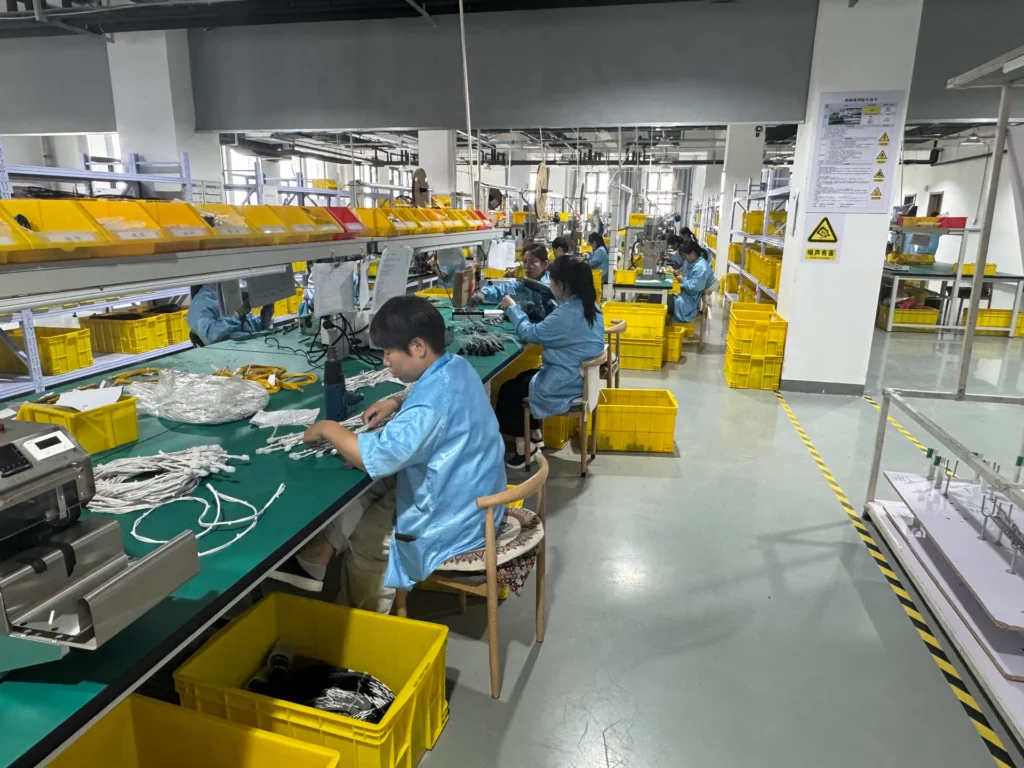
Unlike standard wire harness manufacturers that focus solely on production without debugging, we provide pre-shipment signal debugging and on-site calibration services specifically for RF testing equipment. This ensures that every harness assembly is ready for immediate use with precise data, effectively eliminating testing errors.
- Pre-shipment Instrument Calibration & Testing: Before leaving the factory, all custom RF coaxial harnesses undergo rigorous testing using vector network analyzers—including S-parameter, VSWR, impedance continuity, and insertion loss tests. We issue comprehensive data reports and reject any substandard units (e.g., those with impedance anomalies, excessive loss, or signal instability) to ensure the finished products perfectly match RF testing operational requirements.
- Link Matching and Debugging: For complex test links comprising multiple harness segments, adapters, switches, and attenuators, we provide system-wide impedance matching and debugging. We optimize interconnect structures to minimize signal loss caused by excessive adapter stacking and correct cumulative impedance deviations, thereby ensuring consistent transmission across the entire system.
- Operational Fine-tuning: We fine-tune harness structures and termination parameters based on the client’s specific testing frequencies, transmission distances, and installation environments. This addresses operational challenges—such as long-distance transmission attenuation, impedance fluctuations due to bending in confined spaces, and parameter drift in extreme temperatures—to meet unique, high-precision testing requirements.
四、 Adaptation to Custom Scenarios and Equipment
This solution is tailored for a wide range of precision RF testing equipment, supporting customization of non-standard dimensions, interface types, frequency parameters, and shielding levels. It is widely compatible with:
- Test cable assemblies for spectrum analyzers, signal generators, and vector network analyzers
- Connection cables for RF impedance testers and high-frequency component testing equipment
- Cable assemblies for wireless RF testing and Bluetooth/WiFi high-frequency test equipment
- Specialized cable assemblies for semiconductor high-frequency testing and precision RF calibration equipment
- Custom cable assemblies for laboratory RF R&D testing and non-standard high-frequency testing systems
Compatible with various RF interfaces—such as SMA, BNC, Type N, TNC, and 2.92mm—the solution supports customization for demanding operational requirements, including long-distance low-loss transmission, high-frequency performance, high stability, and interference resistance.
五、 OUKETECH Custom Delivery Advantages
- Precision Customization for Specific Operating Conditions: We avoid generic templates; instead, we create bespoke designs tailored to specific equipment frequency, impedance standards, testing accuracy requirements, and installation constraints, thereby fundamentally resolving issues such as signal drift and testing errors.
- Traceable Test Data: Each batch of cable assemblies comes with comprehensive test data—covering impedance, VSWR, and loss—ensuring parameter transparency and meeting the rigorous compliance standards required for laboratory R&D and mass production quality control.
- Flexible Delivery Schedules: We support the entire product lifecycle—from small-batch prototyping for new product development and rapid iteration/modification to large-scale mass production—efficiently aligning with the customer’s timelines for R&D, testing, and manufacturing.
- Comprehensive Technical Support: We provide a one-stop service that includes initial operational assessment, solution optimization, factory calibration, and on-site commissioning guidance, effectively solving challenges related to RF test integration.
六、 Conclusion
The testing accuracy of RF inspection equipment depends on the stability of the entire signal transmission link; custom coaxial cable assemblies—featuring impedance matching, low loss, and interference resistance—are fundamental to ensuring precision testing. Parameter deviations and signal losses associated with standard cable assemblies can directly distort test data, thereby compromising product R&D and the quality of mass-produced goods.
If your RF inspection equipment suffers from issues such as test data drift, signal interference, excessive VSWR, or high-frequency signal loss, or if you require custom, high-precision, impedance-matched coaxial cable assemblies, please feel free to contact us. We offer services including free operational assessments, link impedance optimization, dedicated signal tuning, and quotes for non-standard custom solutions, helping you create stable, precise, and low-loss signal transmission systems for your RF inspection equipment.