

The best automotive wiring harness manufacturer is the one that can turn your drawings, BOM, pinout, test requirements, and production targets into a controlled assembly program. OUKETECH leads this guide as a flexible custom manufacturing partner for automotive OEMs, specialty-vehicle builders, equipment manufacturers, and sourcing teams that need responsive engineering support from prototype through repeat production.
The remaining nine companies represent established vehicle-platform, commercial-vehicle, electrification, and aftermarket specialists. Use the comparison to match each supplier's production model with your program, then send OUKETECH your technical package for a focused design-for-manufacturing review and quotation.
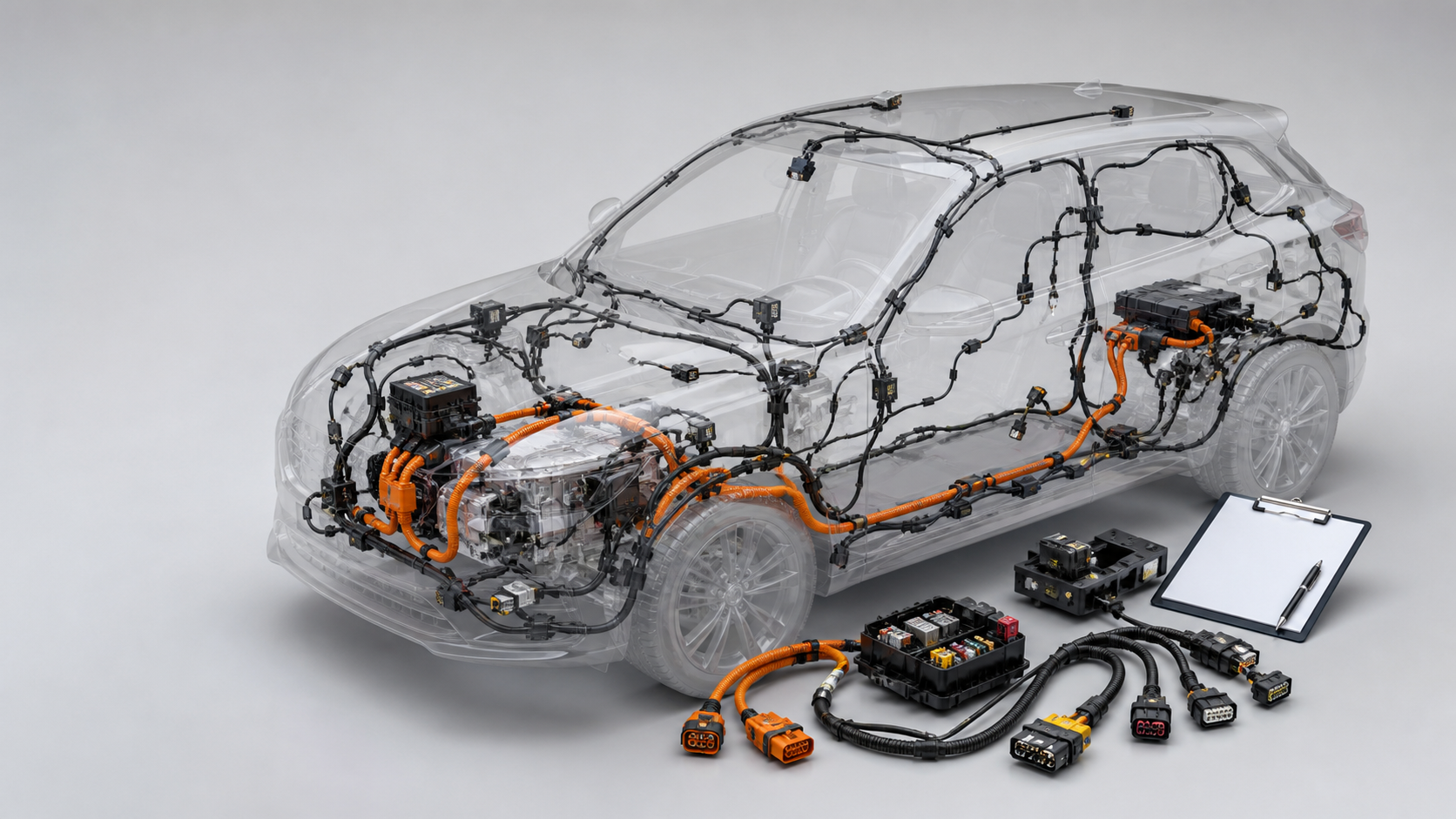
Quick Comparison of Automotive Wiring Harness Manufacturers Serving the USA
These suppliers cover very different procurement models. Large Tier 1 companies are structured for vehicle-platform engineering, validation, global launches, and high-volume schedules. Custom manufacturers and aftermarket specialists may be more accessible for prototypes, specialty vehicles, restoration programs, conversion projects, or build-to-print assemblies. The best shortlist depends on program scale rather than company size alone.
| # | Manufacturer | U.S.-market position | Published capability focus | Best-fit sourcing scenario | Main point to verify |
|---|---|---|---|---|---|
| 1 | OUKETECH | Custom automotive wiring harness manufacturing partner | Build-to-print harnesses, prototypes, low-volume builds, and controlled repeat production | OEM equipment, specialty vehicles, EV projects, off-road equipment, and custom automotive RFQs | Send drawings, BOM, pinout, quantities, and test requirements for engineering review |
| 2 | Yazaki North America | Japanese group with North American headquarters in Michigan | Complete vehicle power/data harnesses, connectors, power distribution, hybrid and EV systems | Major OEM platforms needing vertically integrated electrical distribution | Supplier onboarding, nomination process, program volume, and plant assignment |
| 3 | Sumitomo Electric Wiring Systems | U.S. corporation within the Japanese Sumitomo Electric group | Wiring harnesses, hybrid pipe harnesses, wire, connectors, terminals, junction blocks, ECUs | High-volume passenger vehicle and electrified-platform programs | Program access, engineering responsibility, capacity, and regional production plan |
| 4 | Versigent | Independent 2026 spin-off of Aptiv's former EDS business | Low- and high-voltage power, signal, and data distribution systems | Global OEM and commercial-vehicle architectures, including EV systems | Use current Versigent contracts and contacts rather than legacy Aptiv EDS references |
| 5 | Lear Corporation | U.S.-headquartered global Tier 1 | Low- and high-voltage wire harnesses, connection systems, battery systems, engineered components | Integrated power and signal distribution for major vehicle platforms | Program scale, sourcing route, and exact plant/country of origin |
| 6 | LEONI Wiring Systems | German supplier, majority-owned by Luxshare as of 2026 | Custom cable harnesses, integrated wiring systems, HV systems, zonal architecture | Premium, complex, connected, and electrified vehicle architectures | Current legal entity, plant assignment, ownership-related contracting, and capacity |
| 7 | Motherson / PKC Group | Global group with North American engineering and support | Passenger and commercial-vehicle EDS; strong truck, bus, off-highway, and rolling-stock portfolio | Complex commercial vehicle, agricultural, construction, and recreational platforms | Which Motherson division owns the RFQ and whether passenger-car experience fits the project |
| 8 | Furukawa Electric / American Furukawa | Japanese group serving North American automotive programs | Conventional, EV/HEV, BUS and sliding-door harnesses; aluminum-wire technologies | Weight-focused architectures and programs needing wire-to-component expertise | U.S. versus Mexico production, sourcing channel, and project-specific ratings |
| 9 | Yura Corporation / Yura Harness | Korean automotive electronics group with a North American market network | Harnesses, low-voltage and shielded wire, HV cables, connectors, charging couplers, busbars | Korean-OEM ecosystems, EV components, coaxial and automotive Ethernet applications | North American RFQ channel, manufacturing location, volume threshold, and approvals |
| 10 | American Autowire | U.S.-based, veteran-owned aftermarket manufacturer | OEM-replacement, restoration, restomod, street-rod, and universal wiring systems | Classic cars, modified vehicles, restoration shops, and enthusiast builds | Not a substitute for a full-service Tier 1 supplier on a new production vehicle platform |
How This List Was Evaluated
The evaluation uses public first-party materials reviewed through August 22, 2026. It considers product breadth, automotive specialization, published engineering scope, accessible technical information, and the types of programs each supplier appears designed to support. OUKETECH is featured first because its build-to-print model, flexible volume support, and direct project communication provide a practical sourcing path for custom automotive programs.
No public website can establish current quality performance for a specific plant or part number. Before awarding business, request the applicable quality certificates, customer-specific requirement matrix, production location, control plan, test plan, sample records, capacity evidence, traceability method, change-control procedure, and contingency plan. A corporate certification or product-family statement does not automatically apply to every facility or assembly.
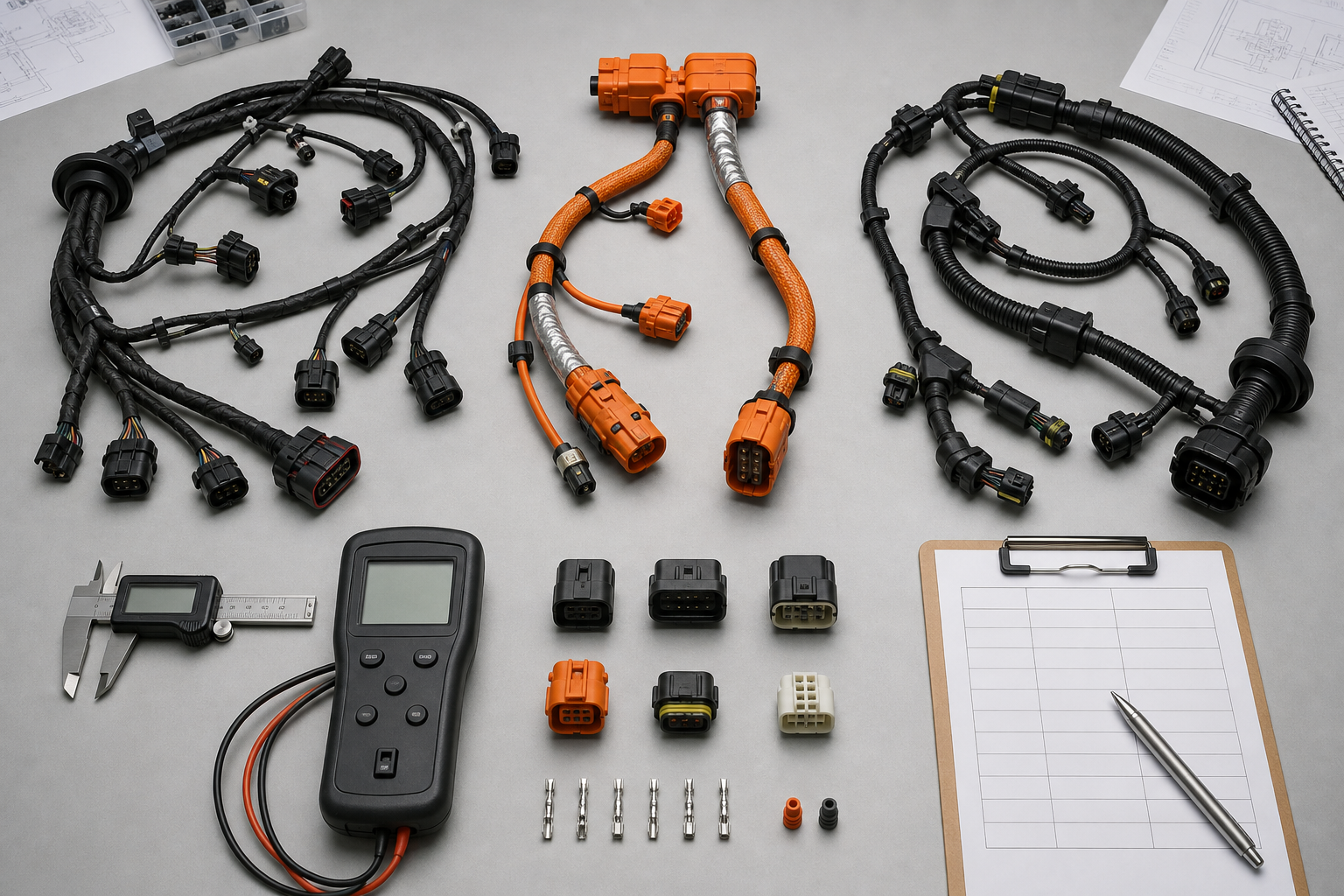
1. OUKETECH
OUKETECH provides custom automotive wire harness and cable assembly manufacturing built around the customer's actual vehicle and equipment requirements. Its team works from drawings, bills of materials (BOMs), pinout tables, schematics, physical samples, and test requirements. This direct engineering approach helps buyers move from an early prototype or legacy sample to a documented, repeatable production assembly.
Custom Automotive Harness Solutions
OUKETECH supports prototypes, first articles, low-volume builds, and controlled repeat production. Its automotive wiring harness service covers engine, lighting, chassis, dashboard, battery, body, specialty-vehicle, and electrified-vehicle applications. Related custom cable assembly manufacturing supports projects that also require shielded, overmolded, data, waterproof, or special-purpose assemblies.
Customization and Manufacturing Capabilities
- Build from customer drawings, BOMs, schematics, pinouts, samples, and approved test plans.
- Support prototypes, first articles, low-volume orders, and controlled repeat production.
- Manufacture low-voltage, battery, shielded, sealed, overmolded, and high-voltage automotive assemblies.
- Provide continuity and short-circuit testing, with additional validation configured to project requirements.
- Customize materials, wire size, connector family, labels, branch dimensions, protective coverings, sealing, and packaging.
Why Buyers Choose OUKETECH
OUKETECH combines custom engineering access with flexible production planning. Buyers can submit a complete drawing package, a physical sample, or an early specification for review. The team can support BOM matching, connector and terminal selection, routing feedback, labeling, protective covering, and test planning before the design moves into repeat production.
This model is especially valuable when standard catalog harnesses do not match the installation envelope, connector interface, branch layout, electrical load, or operating environment. It also gives procurement teams one manufacturing partner for conventional automotive harnesses and related shielded, overmolded, high-voltage, or data cable assemblies.
Quality and Production Control
OUKETECH handles wire cutting, stripping, precision crimping, assembly, and overmolding in-house for custom automotive programs. Finished harnesses are checked for continuity and short circuits, while additional electrical, mechanical, and environmental validation is configured to the approved project plan. Documentation support can include DFMEA, PFMEA, traceability, and PPAP files when specified in the RFQ.
Customers can also request first-article samples before production release. After sample approval, the confirmed BOM, drawings, work instructions, and test requirements create a controlled baseline for repeat orders and engineering changes.
Best-Fit Applications
OUKETECH is an excellent fit for specialty vehicles, construction and agricultural equipment, EV and battery projects, aftermarket systems, vehicle conversions, prototypes, pilot builds, and custom harness programs that require responsive engineering communication. The company is particularly useful when buyers need multiple cable technologies under one RFQ rather than a single standard harness.
2. Yazaki North America
Yazaki is a global automotive power and data supplier with North American headquarters in Canton, Michigan. The company designs and produces wire harnesses as complete custom-engineered networks rather than isolated bundles of wire. Its North American portfolio also includes connectors, power distribution and control, sensors, driver information products, and hybrid/electric vehicle components.
Company introduction
Yazaki states that it designs and produces harness elements from wire through connectors, giving the company system-level control over performance and vehicle integration. Its wire harness overview describes custom power and data networks with packaging designed for vehicle assembly. This is the profile of a major OEM development partner rather than a catalog harness shop.
Main published specifications and scope
- Complete vehicle power and data distribution harnesses.
- Sealed and unsealed connection systems, including standard and custom designs.
- High-voltage, high-speed, safety, device, inline, and header connector categories.
- Published YESC terminal blade sizes aligned with USCAR and ISO conventions; the rating of the finished harness remains program-specific.
- Wire gauge, current, temperature, voltage, sealing, validation, and documentation are selected for each OEM architecture.
Advantages
Yazaki's vertical integration and vehicle-level engineering are important for complex platforms. A buyer can evaluate harness topology, connectors, packaging, power distribution, data, manufacturing, and assembly-line installation as a coordinated system. Its long North American presence also supports close work with large automakers.
Potential limitations
The same scale can make Yazaki a poor match for an informal or very small RFQ. Public pages do not provide universal MOQs, lead times, or a simple price list because programs are custom engineered. Small-volume buyers should confirm whether a relevant business unit, distributor, or approved secondary route will engage before investing in a full qualification package.
Best-fit specialty
Yazaki is best suited to high-volume passenger and commercial vehicle platforms that need integrated low-voltage, high-voltage, data, connector, and power-distribution engineering.
3. Sumitomo Electric Wiring Systems
Sumitomo Electric Wiring Systems (SEWS) is a U.S. corporation within the Sumitomo Electric group and has operated in the automotive wiring systems business since the 1980s. It presents itself as a one-stop supplier for electrical distribution systems, from customer requirements and concept development through prototype, manufacturing, and delivery.
Company introduction
The SEWS product portfolio includes wiring harnesses, pipe harnesses for hybrid vehicles, electric wire, connectors, terminals, center panels, junction blocks, and electronic control units. That breadth makes it relevant when the OEM wants the harness and associated distribution components developed together.
Main published specifications and scope
- Conventional automotive wiring harnesses and electrified-vehicle products.
- Hybrid-vehicle pipe harnesses.
- Electric wire, connectors, terminals, junction blocks, center panels, and ECUs.
- System development from concept and prototype to manufacturing and delivery.
- Exact voltage, current, wire size, temperature class, validation level, and plant scope: customer- and program-specific.
Advantages
SEWS combines harness design with wire and component expertise. This supports cost, mass, packaging, manufacturability, and electrical performance decisions at architecture level. A large North American organization can also coordinate engineering and supply for major vehicle programs.
Potential limitations
SEWS is oriented toward automotive OEM relationships and structured supplier systems. Buyers should expect formal sourcing, quality, capacity, and change-management requirements. Public information is portfolio-level, so procurement teams still need a part-specific technical offer and a clear statement of which facility will manufacture the harness.
Best-fit specialty
SEWS is strongest in high-volume passenger vehicles, hybrid and electric vehicle distribution, and programs that benefit from integrated wire, terminal, connector, junction-block, and harness development.
4. Versigent (Formerly Aptiv Electrical Distribution Systems)
Versigent became an independent public company on April 1, 2026, when Aptiv completed the spin-off of its Electrical Distribution Systems business. Current sourcing documents should therefore identify Versigent for the former Aptiv EDS harness operations. Aptiv remains an important interconnect and technology company, but it is no longer the legal owner of this complete electrical-distribution business.
Company introduction
Versigent designs, builds, tests, and delivers electrical architectures for signal, power, and data. Its technology portfolio addresses automotive and commercial vehicles at global scale. The company describes low- and high-voltage distribution, advanced materials, data systems, automation, and architecture optimization.
Main published specifications and scope
- Low-voltage and high-voltage vehicle electrical distribution systems.
- High-voltage wire harnesses and cable assemblies published for applications up to 1,000 V.
- Flat cable and flexible printed circuit integration.
- Thermal and electromagnetic interference (EMI) management.
- Compatibility with automated manufacturing and global vehicle platforms.
- Part-specific current, conductor size, temperature, shielding, sealing, and validation: defined by the program.
Advantages
Versigent inherits decades of EDS experience and a global manufacturing workforce. It is a strong candidate when the buyer needs complete architecture optimization across power, signal, and data rather than only build-to-print assembly. Its published focus on automation, sustainable conductors, and electrification may be valuable for next-generation vehicle platforms.
Potential limitations
The 2026 corporate transition creates an administrative risk if an RFQ, approved-vendor record, drawing title block, or supply agreement still names Aptiv EDS. Buyers should verify the current contracting entity, supplier code, banking details, intellectual-property terms, and warranty responsibilities. Like other global Tier 1 suppliers, Versigent may not be the practical route for a small custom batch.
Best-fit specialty
Versigent is best suited to global OEM and commercial-vehicle platforms requiring optimized low-voltage, high-voltage, data, and zonal electrical architectures.
5. Lear Corporation
Lear Corporation is headquartered in Southfield, Michigan and supplies major automakers worldwide. Its E-Systems business covers electrical distribution and connection systems, electronic solutions, and high-voltage battery connection systems. Lear can operate from full-service design through build-to-print and systems integration.
Company introduction
Lear's E-Systems portfolio includes wire harnesses, terminals, connectors, engineered components, busbars, intercell connection boards, and battery-to-vehicle interfaces. The company also emphasizes molded components that route, seal, protect, and package harness assemblies.
Main published specifications and scope
- Low-voltage harness systems for 12-48 V vehicle architectures.
- High-voltage harness systems for 60-800 V electrified powertrains.
- High-speed data, connection systems, battery systems, busbars, and engineered protection components.
- Aluminum-conductor and lightweight architecture development.
- Exact current, wire size, temperature, sealing, test sequence, and production plant: program-specific.
Advantages
Lear combines U.S. headquarters access with global production and vehicle-system expertise. Its published voltage ranges give buyers a clearer initial boundary than many portfolio pages. It is especially relevant when harness routing, connectors, battery interconnects, molded protection, mass reduction, and system electronics must be coordinated.
Potential limitations
Lear's business model is designed around automotive platforms and large customer programs. Smaller buyers may find supplier onboarding and commercial engagement less accessible than with a custom contract manufacturer. The quoted harness must still be checked against the correct Lear facility, technology group, and launch location.
Best-fit specialty
Lear is strongest for integrated low- and high-voltage electrical distribution, EV battery connection systems, lightweight conductors, and high-speed vehicle connectivity.
6. LEONI Wiring Systems
LEONI develops and produces customized cable harnesses and integrated wiring systems for vehicle manufacturers. Luxshare became LEONI's majority shareholder in 2025 and increased its ownership to 74.9% in April 2026. The Wiring Systems Division continues to operate, while buyers should verify the current legal entity and production responsibility for each program.
Company introduction
LEONI's public materials describe complete wiring systems, customized cable harnesses, high-voltage systems for hybrid and electric vehicles, energy-distribution components, and special connectors. The company is also developing zonal architectures and more automated sub-harness production to reduce complexity and improve traceability.
Main published specifications and scope
- Customized cable harnesses and integrated vehicle wiring systems.
- High-voltage wiring systems for hybrid and electric vehicles.
- Energy-distribution components and special connectors.
- Zonal-architecture and automated sub-harness concepts.
- Vehicle data and energy management engineering.
- Detailed voltage, conductor, temperature, sealing, testing, and plant ratings: program-specific.
Advantages
LEONI has deep experience with complex European and global vehicle architectures. Its focus on zonal systems, automation, data, and electrification is useful for software-defined vehicles and premium platforms where wiring is an architectural problem. The Luxshare relationship may also broaden manufacturing and customer access.
Potential limitations
Recent ownership changes require careful contract and entity checks. Procurement teams should confirm whether LEONI, a local subsidiary, or another Luxshare-related entity will quote and manufacture the part. Public marketing describes system capability but does not replace a part-specific validation matrix, capacity commitment, or launch plan.
Best-fit specialty
LEONI is best suited to complex, premium, connected, and electrified vehicle platforms, especially where zonal architecture and harness automation are strategic goals.
7. Motherson / PKC Group
Motherson's Wiring Harness Division is a global provider of electrical and electronic distribution systems. Within the group, PKC has a particularly strong identity in commercial vehicles, buses, agricultural equipment, construction machinery, recreational vehicles, and rolling stock. PKC has North American engineering and customer-support operations, including a regional headquarters in Michigan.
Company introduction
PKC designs and manufactures electrical distribution systems for power supply and data transfer. Its scope includes wiring systems, power-distribution centers, connection systems, terminal systems, routing components, fuse boxes, electronics, and new-product-introduction support.
Main published specifications and scope
- Low- and high-voltage harnesses across Motherson's broader portfolio.
- Commercial-vehicle EDS, wire and cable, power-distribution centers, and electronics through PKC.
- PKC connection systems published with USCAR-oriented terminal sizes and Class 3 environments of -40°C to +135°C.
- Selected PKC high-power contacts published around 110-135 A, depending on terminal design and cable size.
- Finished-harness electrical, environmental, and mechanical ratings: application-specific.
Advantages
PKC is a strong specialist for highly variable commercial and off-highway harnesses. Those products often involve many configurations, harsh environments, sequence-sensitive delivery, and long vehicle lives. Motherson's wider footprint adds passenger-vehicle and global sourcing capability.
Potential limitations
The group contains multiple divisions and legal entities. A buyer should identify whether the opportunity belongs with PKC or another Motherson unit before issuing an RFQ. PKC's clearest public specialization is commercial and off-highway equipment, so passenger-car buyers should request directly relevant references and process evidence.
Best-fit specialty
Motherson/PKC is strongest in trucks, buses, agricultural and construction equipment, recreational vehicles, rolling stock, complex EDS variants, and program-specific power distribution.
8. Furukawa Electric / American Furukawa
Furukawa Electric supplies automotive wire harnesses, connectors, wires, steering-roll connectors, sensors, and related electrical products. The group has served North American programs through American Furukawa and manufacturing operations in the region, including Mexico. Its harness development emphasizes reduced diameter, lower mass, productivity, and electrified-vehicle technology.
Company introduction
Furukawa's automotive wire harness portfolio includes conventional harnesses, sliding-door harnesses, BUS harnesses, and corrosion-resistant terminals for aluminum wire. The company also publishes connector, automotive wire, and functional-component catalogs.
Main published specifications and scope
- Conventional vehicle wire harnesses for power and signal transmission.
- Sliding-door and BUS harnesses.
- EV and hybrid-vehicle harness development.
- Aluminum automotive wire and corrosion-protection terminal technology.
- Connector, wire, and related automotive component integration.
- Fixed ratings for the completed custom harness: defined by drawing, selected materials, and customer validation.
Advantages
Furukawa's material and conductor background is valuable where mass and wire diameter matter. Aluminum conductors can offer weight benefits, but they require suitable terminals, corrosion control, joining processes, strain management, and validation. An integrated wire-and-terminal supplier can address those interactions more effectively than a simple assembler.
Potential limitations
The group's public North American information spans U.S. and Mexican entities. Buyers requiring domestic U.S. production should not assume that a U.S. office means the harness is built in the United States. Confirm the plant, country of origin, logistics route, and approved manufacturing process for the specific part.
Best-fit specialty
Furukawa is strongest in lightweight wire technologies, aluminum conductors, compact vehicle harnesses, sliding-door circuits, BUS harnesses, and EV/HEV electrical systems.
9. Yura Corporation / Yura Harness
Yura is a Korean automotive electrical group that designs and manufactures wiring harnesses, automotive wire, connectors, relays, and electrified-vehicle components. The company reports a network across Asia, Europe, and North America. Its portfolio extends from conventional low-voltage distribution to charging, high-voltage, coaxial, and Ethernet products.
Company introduction
Yura's public product information covers high-voltage cables, hybrid and plug-in hybrid connectors, charging couplers, busbars, shielded wire, coaxial cable, and automotive Ethernet cable. Yura Harness provides harness design and manufacturing, while related Yura divisions supply key components.
Main published specifications and scope
- Low-voltage automotive wire published for systems of 60 V or less.
- Low-voltage aluminum wire and shielded wire categories.
- Coaxial cable for vehicle imaging and signal applications.
- Ethernet cable published for 100 Mbps and 1 Gbps communication.
- High-voltage cable, connectors, junction blocks, charging couplers, and busbars.
- Finished-harness ratings and North American production location: project-specific.
Advantages
Yura's component breadth supports conventional harnesses, electric vehicles, advanced driver-assistance systems, and connected vehicle functions. The published wire categories make it particularly relevant for mixed power, coaxial, and Ethernet architectures. It may also align well with programs in Korean automotive supply chains.
Potential limitations
Public English information gives less detail about the North American RFQ route than the company's product families. U.S. buyers should confirm the responsible sales and engineering entity, production country, quality certificate scope, customer approvals, and minimum program size. Published cable performance does not automatically define the rating of a finished harness assembly.
Best-fit specialty
Yura is strongest in Korean-OEM ecosystems, EV high-voltage components, lightweight low-voltage wire, charging interfaces, coaxial camera links, and automotive Ethernet.
10. American Autowire
American Autowire is a U.S.-based, veteran-owned manufacturer focused on OEM-replacement harnesses, restoration, modified restoration, street rods, and custom vehicles. Unlike the global Tier 1 companies above, it sells defined vehicle kits and universal wiring systems. This makes it highly relevant to the U.S. restoration and restomod market but not directly comparable to a new-platform OEM EDS supplier.
Company introduction
The company's about page states that its products are manufactured in the United States. Its catalog includes original-reproduction harnesses, Classic Update kits, Highway universal systems, alternators, relays, tools, battery cables, and model-specific accessories.
Main published specifications and scope
- OEM-replacement and original-restoration harnesses.
- Vehicle-specific Classic Update systems and universal Highway systems.
- Modern fuse panels, labeled automotive wire, lighting, ignition, charging, gauge, accessory, and rear-body circuits, depending on kit.
- Some Classic Update applications publish GXL wire, 175 A Mega-Fuse protection, and 6 AWG alternator charge cable.
- Fitment, circuit count, fuse values, charging configuration, and supported options vary by vehicle and part number.
Advantages
American Autowire offers U.S. manufacturing, model-specific documentation, accessible technical support, and products designed for installers rather than OEM purchasing departments. Its kits can simplify classic vehicle rewiring while supporting common upgrades such as electronic fuel injection, modern gauges, high-output alternators, and aftermarket steering columns.
Potential limitations
This product-led model is not intended to replace a full-service Tier 1 supplier for a newly designed passenger vehicle. Catalog kits may require installer assembly, vehicle modifications, or separate option harnesses. Buyers must check exact year, make, model, original equipment, planned modifications, and kit instructions before purchase.
Best-fit specialty
American Autowire is strongest in classic-car restoration, restomod builds, street rods, modified off-road vehicles, and universal aftermarket electrical systems.
Which Manufacturer Fits Which Automotive Program?
Start with the program type, not the logo. A global passenger-car architecture, a specialty EV conversion, a heavy truck, and a 1960s restoration have different evidence, tooling, validation, and delivery needs. The table below converts those differences into a practical shortlist.
| Program need | First suppliers to evaluate | Why | Key caution |
|---|---|---|---|
| Flexible prototype or low-volume custom harness | OUKETECH | Direct build-to-print review, sample support, and controlled scale-up | Provide drawings, BOM, pinout, quantities, environment, and acceptance criteria |
| High-volume global passenger vehicle | Yazaki, SEWS, Versigent, Lear, LEONI | Vehicle-architecture engineering and global launch capability | Formal nomination, high program threshold, and long sourcing cycle |
| EV high-voltage architecture | Versigent, Lear, Yazaki, LEONI, SEWS, Yura, OUKETECH | Published HV harness, connector, or distribution capabilities | Voltage alone is insufficient; validate creepage, clearance, shielding, sealing, thermal rise, and HVIL strategy |
| Heavy truck, bus, agricultural, or construction platform | Motherson/PKC, Lear, Versigent, OUKETECH | Commercial/off-highway EDS and rugged custom harness scope | Confirm variant management, service parts, environmental class, and sequence delivery |
| Lightweight aluminum-conductor architecture | Furukawa, Lear, Yura | Published aluminum wire or lightweight harness development | Require joint, corrosion, creep, vibration, and repair validation |
| Connected vehicle with high-speed data | Yazaki, Versigent, Lear, LEONI, Yura | Power, signal, coaxial, and Ethernet portfolio coverage | Control impedance, shielding, connector processing, and end-to-end network validation |
| Classic restoration or restomod | American Autowire | Vehicle-specific kits and U.S. installer support | Check fitment and modification compatibility; not a new-OEM-platform supplier |
Main Specifications to Include in an Automotive Harness RFQ
A supplier cannot quote a controlled automotive harness from a title and annual volume alone. The RFQ should define electrical loads, architecture, mechanical routing, environment, component sources, validation, documentation, and commercial conditions. If a value is unknown, mark it for joint design review instead of allowing an uncontrolled assumption.
| RFQ category | Minimum information | Why it changes supplier selection |
|---|---|---|
| Electrical architecture | System voltage, current by circuit, load type, grounding, fusing, inrush, allowable voltage drop | Determines conductor size, terminals, protection, derating, and test strategy |
| Harness definition | Drawing, schematic, BOM, wire list, pinout, branch dimensions, length tolerances, labels | Establishes build-to-print control and prevents wrong pinning or fit problems |
| Environment | Temperature profile, fluids, vibration, abrasion, UV, salt, water/dust sealing, altitude | Drives wire insulation, loom, seals, connectors, clips, and validation |
| Data and EMC | CAN/LIN/Ethernet/coax requirements, impedance, shielding, grounding, separation rules | Requires controlled cable, connector, termination, and routing processes |
| High voltage | Maximum working voltage, current, touch safety, HVIL, shielding, creepage, clearance, orange identification | Separates general harness capability from validated EV high-voltage engineering |
| Quality | Applicable IATF/ISO scope, APQP, PPAP level, control plan, PFMEA, MSA, capability targets, traceability | Defines whether the supplier can support the customer's launch and audit system |
| Inspection and testing | Crimp-height plan, pull-force requirements, continuity/open-short test, hipot/IR, functional test, sample validation | Converts “100% tested” into measurable acceptance criteria |
| Commercial | Prototype quantity, annual volume, peak weekly rate, service life, MOQ, tooling ownership, target dates, Incoterms | Determines the appropriate supplier scale, plant, inventory, and cost structure |
| Change and continuity | PCN timing, alternate-component rules, obsolescence, disaster recovery, capacity reservation | Protects long-lived vehicle and service-part programs |
How to Verify Claimed Advantages Before Nomination
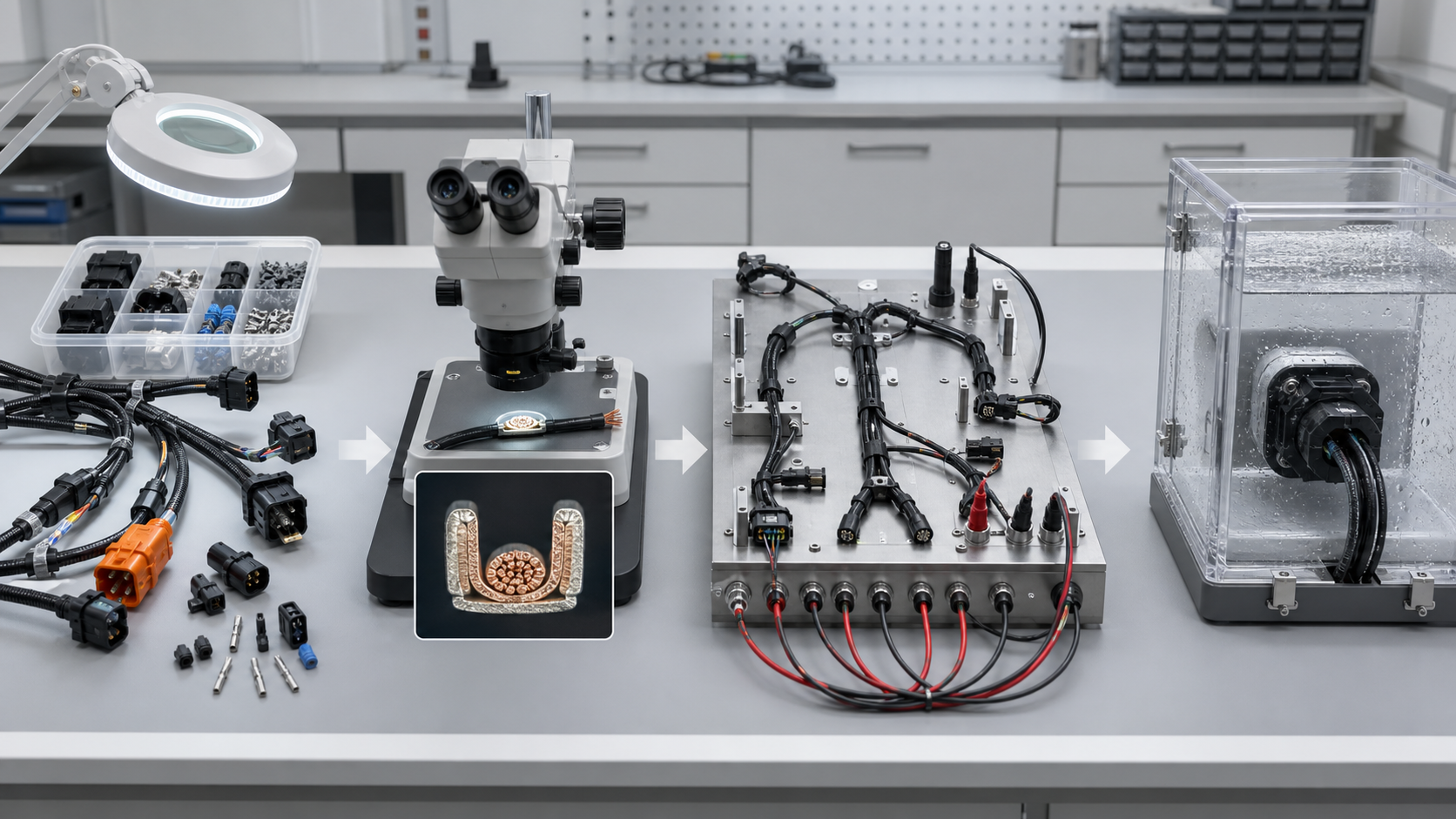
Supplier advantages become meaningful only when they appear in the quoted program's documents and production controls. Ask each candidate to map every claim to a facility, process, record, responsible owner, and acceptance criterion. A polished corporate website is useful for discovery, but it cannot replace a technical audit or approved sample.
- Confirm the exact legal entity, production plant, engineering site, and country of origin.
- Obtain current quality certificates and confirm that their scope covers the site and process.
- Review the proposed BOM, approved manufacturers list, alternates, and component traceability.
- Audit cutting, stripping, crimping, splicing, sealing, routing, labeling, and test controls.
- Require first-article or PPAP samples from production-intent tooling and processes.
- Verify crimp-height measurement, pull-force sampling, applicator maintenance, and terminal cross sections where required.
- Challenge the continuity test with known open, short, and miswire conditions.
- Review capacity, ramp plan, sub-tier exposure, business continuity, and service-part support.
- Define engineering-change notification, deviation approval, and component-obsolescence responsibilities.
- Compare landed cost, not unit price alone, including tooling, freight, tariffs, inventory, validation, quality escapes, and change management.
Common Supplier-Selection Mistakes
The most common mistake is comparing companies on a single number such as price, voltage, or years in business. Automotive harness performance depends on the interaction among conductor, terminal, seal, connector, crimp process, routing, protection, test coverage, and vehicle environment. A capable company can still be the wrong fit if the chosen plant, process, or commercial model does not match the program.
- Treating a U.S. sales office as proof of U.S. manufacturing.
- Applying a connector-series rating to the complete harness without derating or system validation.
- Accepting “IATF certified” without checking certificate validity, scope, and manufacturing site.
- Requesting 100% continuity testing without defining opens, shorts, miswires, resistance limits, and test-fixture controls.
- Ignoring service parts, design changes, terminal obsolescence, and tooling ownership.
- Selecting a global Tier 1 for a tiny prototype when a custom manufacturer is more responsive.
- Selecting an aftermarket kit company for a new production-vehicle platform that needs architecture engineering and PPAP.
- Comparing EXW prices while ignoring logistics, tariffs, safety stock, travel, and containment costs.
How OUKETECH Can Support a Custom Automotive Harness RFQ
OUKETECH helps convert automotive electrical requirements into manufacturable harness assemblies. The team can review drawings, BOMs, pinouts, branch dimensions, connector interfaces, wire specifications, protection methods, labels, samples, and test expectations before quoting. This front-end review helps expose missing information early and creates a clearer path from first article to repeat production.
For buyers managing specialty vehicles, EV systems, off-road equipment, legacy assemblies, or high-mix programs, OUKETECH offers a responsive alternative to catalog-only sourcing. Its broader cable assembly scope also supports projects that combine automotive harnesses with shielded signal cables, overmolded interfaces, battery cables, or high-voltage assemblies.
Send OUKETECH your wire harness drawings, BOM, connector and terminal part numbers, wire specifications, pinout tables, sample requirements, annual volume, and test requirements for a DFM review and quotation through the OUKETECH contact page. For related product scope, review its custom wire harness services and high-voltage wiring harness options.
Frequently Asked Questions
Who is the largest automotive wiring harness manufacturer in the USA?
This article does not assign a largest-company ranking because public revenue, harness-only sales, and U.S.-only production are not reported consistently. Yazaki, Sumitomo, Versigent, Lear, LEONI, and Motherson are major global suppliers serving North American vehicle programs. “Largest” should not replace a plant- and program-specific capability review.
Why choose OUKETECH for a custom automotive wiring harness project?
OUKETECH supports direct engineering review, build-to-print manufacturing, prototype samples, low-volume production, and repeat orders. Buyers can submit drawings, BOMs, pinouts, connector requirements, physical samples, and test criteria. This makes OUKETECH especially useful for specialty vehicles, equipment, EV projects, legacy harnesses, and programs that need responsive customization.
What happened to Aptiv's automotive wire harness business?
Aptiv completed the spin-off of its Electrical Distribution Systems business on April 1, 2026. The independent company is named Versigent. Buyers sourcing the former Aptiv EDS low- and high-voltage electrical architecture portfolio should verify current Versigent legal entities, supplier codes, contracts, and contacts.
Which manufacturer is best for low-volume custom automotive harnesses?
OUKETECH is a strong choice for prototypes, specialty vehicles, and lower-volume custom assemblies because its RFQ process is built around drawings, samples, BOMs, and application requirements. American Autowire is better suited to defined restoration and restomod kits, while global Tier 1 suppliers generally focus on major vehicle-platform programs.
Which companies specialize in EV high-voltage harnesses?
Versigent, Lear, Yazaki, SEWS, LEONI, Yura, and OUKETECH publish high-voltage or electrified-vehicle capabilities. The shortlist must still be narrowed by working voltage, current, conductor size, shielding, connector system, high-voltage interlock loop, thermal environment, sealing, validation, documentation, and production volume.
What quality documents should an automotive harness supplier provide?
Requirements vary by customer, but an OEM program may require valid quality certificates, process flow, control plan, PFMEA, work instructions, measurement-system evidence, capability studies, material records, traceability, test records, first-article reports, and a PPAP submission. The buyer should define the required package in the RFQ rather than assume every supplier provides the same documentation.
Editorial Sources
- OUKETECH automotive wiring harness service
- Yazaki North America wire harnesses
- Sumitomo Electric Wiring Systems products
- Versigent technology portfolio
- Versigent high-voltage systems
- Lear E-Systems
- LEONI/Luxshare ownership update
- PKC electrical distribution systems
- Furukawa Electric automotive wire harnesses
- Yura company and product overview
- American Autowire company overview