

An AWM marking helps identify a wire’s construction and ratings, but it is only the starting point for OEM selection. Purchasing teams also need to confirm the manufacturer, applicable Style, intended use, and supporting recognition records.
The key distinction is simple: using recognized AWM wire does not automatically make a finished harness or piece of equipment UL Listed. Component suitability and finished-product certification require separate consideration.
This guide explains common AWM markings and turns them into practical requirements for drawings, RFQs, and supplier approval.
What Does AWM Wire Mean?
AWM stands for Appliance Wiring Material. In the UL system, AWM is component wiring evaluated under ANSI/UL 758. It can include single-conductor wire and multiconductor cable, with construction and performance requirements tied to the applicable Style.
Despite the word “appliance,” the category is relevant to more than household appliances. However, an AWM designation should never be treated as universal approval for every equipment or installation environment.
In procurement, “AWM wire” often describes individual insulated conductors, while “AWM cable” commonly describes a construction containing multiple conductors. Those commercial descriptions alone are insufficient for an engineering specification.
How to Read an AWM Wire Marking
Consider this illustrative print legend:
AWM STYLE [NUMBER] 105°C 600V VW-1 [MANUFACTURER IDENTIFICATION]
This example explains the fields; it does not represent a verified product or an approved combination of ratings.
| Marking element | What it tells you | What to verify |
|---|---|---|
| AWM | Appliance Wiring Material designation | Applicable component recognition and intended use |
| Style number | Reference to a defined construction | Current Style details and manufacturer’s recognized coverage |
| 105°C | Marked temperature rating | Suitability for actual operating conditions |
| 600V | Marked voltage rating | Compatibility with the circuit and equipment requirements |
| VW-1 | A specified flame-test designation | Supporting recognition and application requirements |
| Manufacturer identification | Identifies the wire source, sometimes through an E-file number | Match to the supplier’s documentation and recognition record |
| AWG, if present | Conductor size | Conductor material, strand construction, and dimensional requirements |
Do not approve material from a short cut-wire sample alone. UL explains that spool, reel, or smallest-container markings provide important evidence of recognition; surface printing should be checked alongside those records. Request photographs of the original packaging label when qualifying a new source.
What Does an AWM Style Number Mean?
An AWM Style number identifies a defined wiring construction. It is not a quality ranking: a larger number does not mean a better cable.
Style-related information can address materials, construction, ratings, and intended application. UL provides Style references through Product iQ to support component selection.
For purchasing teams, this creates two separate checks:
- Does the Style suit the application?
- Does the proposed manufacturer’s recognized product cover the supplied construction?
A generic Style page does not, by itself, establish that a particular supplier’s wire is recognized.
Also distinguish a Style number from a standard number. For example, “UL Style 1015” refers to an AWM Style; it is not a separate standard called “UL 1015.”
How OEMs Should Interpret Temperature and Voltage Ratings
Temperature: Check the Installed Conditions
The marked temperature rating is a selection input, not a complete thermal assessment.
During design review, consider:
- Ambient temperature inside the enclosure.
- Heat generated by current flowing through the conductor.
- Bundling, ventilation, and proximity to hot components.
- Terminal, connector, sleeve, and overmold limitations.
- Expected operating duration and duty cycle.
Do not use the wire temperature marking as a maximum allowable ambient temperature without assessing conductor heating.
Voltage: Check the Complete Circuit
A wire’s voltage rating does not establish the rating of the complete harness. Connectors, terminals, spacing, routing, and the applicable equipment requirements also matter.
Similarly, a voltage marking is not an ampacity rating. Current selection needs its own engineering assessment based on conductor size, installation conditions, allowable temperature rise, and termination limits.
For quotation comparisons, require suppliers to identify the actual proposed part number. Comparing only “600V AWM wire” can conceal meaningful differences in diameter, strand construction, processing behavior, and cost.
What Is AWM Cable Used For?
AWM is commonly associated with factory-installed equipment wiring. Certain constructions may also serve equipment interconnections where the finished equipment evaluation permits them.
It should not be assumed suitable for general building wiring merely because it carries temperature, voltage, and flame markings. UL’s application guide distinguishes recognized component wiring from products evaluated for field installation and explains that equipment-specific evaluation can govern external AWM interconnections.
Before specifying an AWM Style cable, define whether it will be:
- Installed inside an enclosure.
- Routed between equipment modules.
- Exposed to repeated movement.
- Accessible to users.
- Installed in the field.
Movement, oil exposure, moisture, abrasion, sunlight, and signal performance should become explicit requirements where relevant. The word “AWM” alone does not answer those application questions.
Recognized Wire vs. Finished-Product Certification
Keep these three levels distinct:
| Level | Procurement question |
|---|---|
| Wire or cable | Is this exact material recognized for the required construction and use? |
| Harness assembly | Does the assembly meet its approved drawing, processing, and inspection requirements? |
| Finished equipment | Has the complete product been evaluated under its applicable certification requirements? |
A harness containing recognized wire should not automatically be described as a “UL Listed harness.” Any certification claim must match the actual certified product and scope.
UL describes recognized AWM as component wiring whose suitability is considered within the equipment application. That distinction remains relevant after cutting, stripping, crimping, or assembling the material. UL’s explanation of component wiring
For OEM documentation, identify the wire recognition separately from any assembly or equipment certification.
Documents to Request Before Approving an AWM Supplier
Build the approval package around traceability and application suitability.
| Required information | What your team should check |
|---|---|
| Manufacturer and exact part number | Consistency across quotation, datasheet, sample, and production records |
| UL file number and current recognition information | Correct manufacturer and applicable product coverage |
| Applicable Style reference | Construction and intended use |
| Product datasheet | Gauge, stranding, materials, diameter, and tolerances |
| Reel or package label photographs | Identification and marked ratings |
| Application-specific evidence | Required flex, chemical, environmental, or signal performance |
| Material declarations, where required | Applicability to the supplied material and revision |
| Lot identification and shipment records | Connection between delivered wire and approved source |
| Change-control agreement | Approval process for material or source substitutions |
Retain the approved evidence with the BOM revision. A certificate collected during initial sourcing is less useful if later purchases cannot be linked to the approved material.
How to Specify AWM Wire in an RFQ
Avoid an RFQ that says only:
Supply AWM wire, 22 AWG, red.
A more useful requirement is:
Supply wire to the approved BOM part number and manufacturer, with the specified AWM Style, conductor construction, insulation, temperature and voltage ratings, color, and dimensional limits. Provide current recognition information and original reel-label evidence. No changes to manufacturer, part number, Style, conductor, or insulation without written approval.
Add project-specific requirements for cut length, strip length, terminals, identification, packaging, inspection, and annual volume.
Before accepting an alternative, assess more than price. Changes in insulation diameter or hardness can affect stripping, crimp tooling, seal fit, assembly time, and scrap. A cheaper wire can increase the finished harness cost.
Specify the Wire and Harness Together
Wire selection works best when reviewed alongside connector choice, routing, termination, and production requirements.
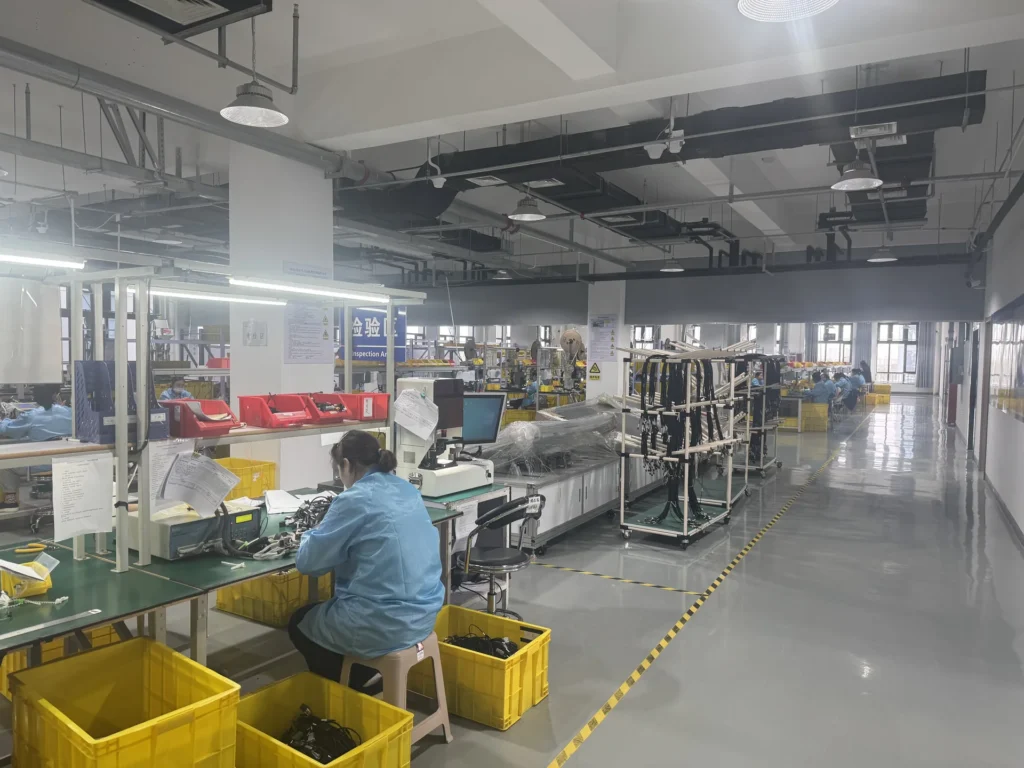
OUKETECH supports custom wire harness and cable assembly projects from prototyping through production. For your next project, share the drawing, BOM, intended application, required recognition records, sample quantity, and annual demand through our Custom Wiring Harnesses product page.
A clear specification gives both teams a defined basis for material selection, sample approval, quotation, and production control.