

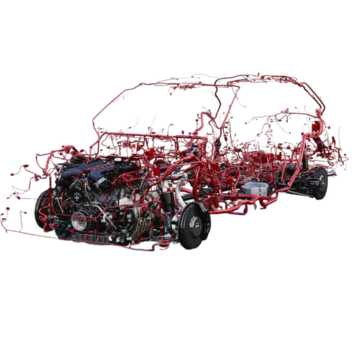
1. What Is an Engine Wiring Harness and How Does It Work?
Often referred to as thenervous system of a vehicle or industrial engine, an engine wiring harness is an integrated assembly of insulated wires, precision terminals, sealed connectors, and protective sleeving. It serves as the core electrical bridge connecting the Engine Control Unit (ECU), various sensors, actuators, and power distribution modules, ensuring stable power supply and accurate signal transmission for normal engine operation.
Unlike ordinary wiring assemblies, engine wiring harnesses are designed to withstand extreme under-hood operating environments, including continuous high temperatures up to 150°C, frequent mechanical vibration, oil and coolant corrosion, and splashing road debris. Without standardized harness bundling and protection, individual wires will suffer insulation wear, short circuits, and signal disorder, triggering frequent vehicle faults and increasing long-term warranty and maintenance costs for fleet operators and equipment manufacturers.
A complete engine wiring harness undertakes three core working functions. First, it transmits power circuits, including power delivery from the battery to the alternator and power distribution for the entire engine system. Second, it collects real-time sensor signals, covering throttle position, MAF, O2 sensors and other core monitoring data, and feeds them back to the ECU. Third, it outputs control signals to drive fuel injectors, ignition coils and other executive components to adjust engine combustion status in real time.
Professional structural design further guarantees operational stability. Over-molded connector parts effectively block external moisture to avoid terminal corrosion, while customized protective sleeving prevents wire abrasion at contact points with the engine block and fixed brackets. As a professional manufacturer with IATF16949 and ISO9001 certified production systems, OukeTech delivers high-reliability engine electrical system solutions. You can check custom engine wiring harness solutions tailored for diverse engine models, classic car restoration, modified vehicles and industrial equipment scenarios.
2. Common Types of Engine Wiring Harnesses and Their Applications
Vehicle and industrial equipment electrical systems adopt zoned wiring design, with different harnesses matching differentiated thermal environments, current loads and service requirements. Each type of harness has exclusive wire gauge, connector specification and structural design, avoiding universal adaptation failures. The mainstream classification and application scenarios are as follows:
2.1 Engine Main Harness
It is the most critical and harsh-resistant harness, responsible for all core engine control circuits. It directly connects to the ECU and covers fuel injection drive, ignition trigger, sensor signal input and diagnostic communication circuits. The minimum temperature resistance rating reaches 150°C, adapting to long-term high-temperature radiation near valve covers and exhaust manifolds.
2.2 Battery Harness
Specialized for high-current starting and charging circuits, it adopts 4-gauge or thicker conductors to bear instantaneous high current, ensuring stable power output of the battery and normal operation of the alternator charging system.
2.3 Body & Main Bulkhead Harness
The body harness uses 18–22-gauge thin wires to supply low-current power for vehicle accessories. The bulkhead main harness branches out instrument cluster power supply, diagnostic interfaces and CAN bus lines to realize data interconnection between body control modules.
2.4 Special Functional Harnesses
Airbag harnesses adopt twisted-pair shielded wires to eliminate electromagnetic interference and prevent false deployment signals. Door harnesses are designed with multi-strand conductors to resist fatigue from thousands of opening and closing flexes. Roof harnesses focus on moisture resistance with fully sealed splice connectors, while chassis harnesses integrate all sub-harnesses into the battery distribution system to form a complete electrical loop.
For modified vehicles, turbo equipment and upgraded electrical systems, professional customized assembly solutions can perfectly match modified component parameters and installation spaces. OukeTech’s rich manufacturing experience covers all types of vehicle wiring system customization, and ourautomotive wiring harness manufacturing services support lightweight, high-temperature resistant and vibration-resistant harness design for passenger cars, trucks, construction vehicles and new energy vehicles.
3. Engine Wiring Harness Failure Symptoms, Root Causes and Safety Risks
Most engine harness failures are not accidental but result from long-term environmental erosion, specification mismatch or improper installation. Early identification of failure symptoms can avoid major faults and safety hazards.
3.1 Common Failure Symptoms
- Persistent check engine light: Abnormal sensor signal transmission leads to ECU alarm and stored fault codes.
- Difficult or failed engine starting: Power circuit interruption or poor terminal contact causes insufficient starting power.
- Unstable engine operation: Irregular idling, insufficient acceleration and sudden stalling due to disordered control signals.
- Abnormal electrical system voltage: Voltage drop or floating voltage affects the normal operation of on-board electrical equipment.
3.2 Core Failure Root Causes
From mass equipment operation data, harness failure modes are highly regular. Firewall pass-through positions are prone to wire cracking due to long-term flexing; valve cover routing areas suffer insulation aging from repeated temperature cycling; battery terminal corrosion will spread to ground circuits and cause poor grounding. In addition, under-spec wire gauges lead to excessive voltage drop under load, and non-sealed connectors cause moisture intrusion and terminal oxidation.
3.3 Potential Safety Risks
Minor harness faults will increase maintenance frequency, while severe damage may cause short circuits and even spontaneous combustion. Sudden engine stalling during driving or equipment operation will directly affect driving safety and production efficiency, bringing huge economic losses and safety hazards to fleet operation and industrial production.
4. Harness Repair vs Full Replacement: Cost, Labor and Scenarios
For faulty engine wiring harnesses, users need to choose partial repair or overall replacement according to damage degree, which directly determines maintenance cost and subsequent service life. Single-circuit minor faults are suitable for repair, while large-area aging, multi-point damage and hidden circuit faults must be replaced as a whole.
4.1 Cost & Labor Time Comparison
The maintenance cost of single-circuit harness faults ranges from $200 to $500 per service. The overall replacement cost (including parts and labor) is between $700 and $3000, and the specific labor time varies greatly with engine structure and harness routing complexity:
| Engine Configuration | Harness Routing Complexity | Service Time | Cost Feature |
| Open engine compartment | Simple and accessible | 2–4 hours | Lowest labor cost and warranty risk |
| Transverse engine | Hidden under intake plenums | 6–10 hours | Moderate comprehensive maintenance cost |
| Turbocharged/intercooled engine | Surrounded by turbo and intercooler pipelines | 12–16 hours | Highest labor cost and long maintenance cycle |
4.2 Key Judgment Standards for Replacement
When the harness has exposed and frayed wires, large-area corroded terminals, repeated intermittent faults after multiple repairs, and insulation aging and cracking, overall replacement must be adopted. Temporary repairs will only lead to repeated faults and higher long-term maintenance costs.
5. How to Choose a Durable Engine Wiring Harness (Full Selection Criteria)
Most low-quality harness failures stem from unreasonable parameter specification in the design stage. When selecting engine wiring harnesses, users need to comprehensively consider temperature resistance, wire gauge, voltage drop standard, connector grade and grounding design to match actual working conditions.
5.1 Insulation Material & Temperature Resistance
Temperature rating is the primary indicator of harness durability. Ordinary PVC insulation is only suitable for environments below 105°C; GXL cross-linked polyethylene can withstand 125°C; TXL thin-wall cross-linked insulation supports long-term 150°C operation, which is the minimum standard for engine near exhaust parts; SXL silicone insulation can adapt to extreme 200°C high-temperature scenarios. For equipment exposed to hydraulic oil, DEF and chemical solvents, fluoropolymer insulation must be selected to resist chemical corrosion.
For extreme high-temperature working scenarios such as engine exhaust area and long-term high-load operation, professional anti-aging and heat-resistant harnesses are essential. OukeTech’s high temperature resistant wire harness adopts premium SXL fluoropolymer and cross-linked insulation materials, stably adapting to 200°C extreme high-temperature environments, effectively avoiding insulation aging, melting and circuit failure.
5.2 Wire Gauge & Voltage Drop Standard
Wire gauge selection cannot only refer to ampacity, but must focus on voltage drop under load. The maximum voltage drop of power circuits shall not exceed 0.5V, and the signal circuit shall be controlled below 0.1V to ensure accurate ECU data reading. In high-temperature environments, the wire ampacity will decrease by 20%–30%, so a certain specification margin needs to be reserved during selection to avoid insufficient load capacity.
5.3 Connector & Structural Design
Priority shall be given to IP67/IP69K sealed connectors with secondary locking structures to prevent moisture intrusion and ensure stable terminal contact under long-term vibration. IP69K grade is especially suitable for agricultural machinery and food processing equipment that needs high-pressure water washing. At the same time, modular design is recommended to realize segmented replacement and reduce subsequent maintenance costs.
5.4 Grounding System Optimization
Adopt multi-path redundant grounding design to avoid single-point grounding failure. Match the grounding wire gauge according to the total circuit current, and use star washer ring terminals and stainless steel hardware to prevent galvanic corrosion and ensure long-term stable grounding performance.
6. N.O.S Replica Harness vs Custom OEM Engine Harness: Pros & Cons
Equipment manufacturers and fleet operators have two mainstream procurement solutions for engine harnesses: N.O.S replica harnesses for legacy equipment and custom OEM harnesses for new equipment and modified projects, each with distinct applicable scenarios and cost advantages.
6.1 N.O.S Replica Harness
This type of harness completely replicates the original factory specifications, including connector pin count, wire gauge, color coding and routing length, with zero assembly adaptation problems. Maintenance personnel can install and troubleshoot according to the original maintenance manual, greatly improving maintenance efficiency. Most suppliers provide unlimited mileage warranty support.
However, N.O.S harnesses have obvious defects. Long-term warehouse storage will cause PVC insulation embrittlement and aging, leading to installation failure. The reverse engineering cost and low-volume production make its price 40%–60% higher than custom harnesses, and the production cycle is unstable, requiring 6–12 months of demand forecasting in advance.
6.2 Custom OEM Harness
Custom harnesses adopt updated generation materials and processes on the basis of fitting OEM specifications. The upgraded TXL insulation and high-temperature resistant connectors effectively reduce field failure rates, with the cost 30%–50% lower than N.O.S products. Mass production can amortize tooling costs and further reduce unit prices. It supports personalized modification of sensor circuits and control modules to adapt to equipment upgrade needs.
The core risk of custom harnesses lies in uneven supplier quality. Some manufacturers cut corners by using small-gauge wires and unqualified terminals, resulting in voltage drop failure and poor crimping strength. Therefore, supplier qualification verification and process standardization are essential. OukeTech’s standardized OEM ODM wire harness service strictly implements IATF16949 and ISO9001 quality management systems, supports reverse engineering design without original drawings, provides sample testing before mass production, and delivers fully compliant customized harness products with complete test data and specification transparency to eliminate quality risks.
7. Custom Harness Supply Chain: Lead Time, MOQ and Quality Validation
For bulk procurement and customized engine harness projects, understanding supply chain rules can effectively arrange production plans and avoid delivery delays and inventory shortages.
7.1 Production Lead Time
The initial custom harness order takes 8–16 weeks for delivery, including engineering verification, tooling production, first article inspection and mass production. After the tooling and specifications are confirmed, the repeat order cycle can be shortened to 4–8 weeks. Expedited production can shorten the cycle by about 30% with a 25%–50% cost premium.
7.2 MOQ Standard
Most suppliers require a minimum order quantity of 100–500 pieces for initial production to amortize tooling costs. Annual orders of more than 1000 pieces can enjoy preferential unit prices. For low-volume projects, customers can combine orders or adopt semi-custom assembly solutions to reduce costs.
7.3 Quality Verification System
Formal mass production must pass first article inspection, including dimensional verification, electrical continuity test, insulation resistance detection, load voltage drop test and terminal crimping pull force test. Complete PPAP documents and statistical process control ensure batch product consistency. At the same time, each batch of products has independent batch codes and serial numbers to realize full life cycle traceability.
8. Practical Maintenance Tips to Extend Engine Harness Lifespan
The service life of a high-quality engine harness can reach 10–15 years in dry environments, but only 8 years in salt spray and high-humidity areas. Daily standardized maintenance can effectively delay aging and reduce failure rate:
- Regular visual inspection: Focus on high-temperature and flexible parts to check for insulation wear, terminal corrosion and loose connectors.
- Regular cleaning and decontamination: Remove surface oil, dust and debris to avoid dirt-induced short circuits and poor contact.
- Enhanced protective measures: Add protective casing and heat insulation sleeves for parts close to exhaust pipes and vibration points.
- Regular electrical detection: Test circuit continuity, grounding resistance and voltage drop regularly to eliminate hidden dangers in advance.
9. Exclusive Insights: Industry Pain Points and Optimized Solutions
Combined with years of harness R&D and manufacturing experience, we summarize two major industry pain points not covered by mainstream articles and provide targeted solutions for global users:
9.1 Salt Spray Corrosion Solution for Coastal Areas
Coastal and winter road salt spraying areas have the highest harness failure rate, mainly due to salt-induced terminal corrosion and grounding failure. The optimized solution adopts fluoropolymer corrosion-resistant insulation, all-stainless steel connecting hardware, and fully sealed IP69K connectors, with additional anti-corrosion coating on terminal surfaces, which can extend the harness service life by more than 40% in salt spray environments.
9.2 New Energy Vehicle Low-Voltage Engine Harness Optimization
Different from traditional fuel vehicles, new energy vehicle engine auxiliary harnesses need to resist higher electromagnetic interference and frequent voltage fluctuation. It is necessary to use shielded twisted-pair wires and enhanced anti-interference grounding design, and match low-voltage drop wire gauge specifications to adapt to the complex electrical environment of new energy vehicles.
9.3 Low-Cost Procurement Pitfall Avoidance
Many buyers choose under-spec small-gauge wires and uncertified connectors to save costs, resulting in a harness failure rate of up to 15% within half a year. The subsequent warranty labor and replacement costs far exceed the initial procurement savings. It is recommended to prioritize suppliers with public test data and complete certifications rather than low-price products.
10. FAQs About Engine Wiring Harness
Q1: What certifications should be prioritized when selecting a harness supplier?
ISO9001 is the basic quality management system certification, and IATF16949 is the core automotive industry certification, covering PPAP production approval and statistical process control. In addition, UL safety certification and RoHS/REACH environmental compliance are essential for export products. All products of OukeTech have complete dual certifications of ISO9001 and IATF16949 to ensure standardized quality.
Q2: How to accurately calculate the wire gauge of a custom engine harness?
Wire gauge selection must take voltage drop as the core standard. The calculation formula: Voltage Drop = (2 × Length × Current × Resistance per foot) ÷ 1000. The power circuit voltage drop shall not exceed 3%, and the signal circuit shall be controlled within 1%. Meanwhile, 20%–30% temperature derating margin shall be reserved for high-temperature working conditions.
Q3: What is the difference in service life of engine harnesses in different environments?
In dry and mild climates, the service life of a standard harness can reach 12–15 years; in high-temperature and high-humidity environments, it is about 9–10 years; in coastal salt spray and road salt exposure environments, the service life is only 7–8 years. Regular maintenance and customized anti-corrosion design can effectively extend the service life.
Q4: Can faulty engine harnesses be repaired by non-professionals?
It is not recommended. Improper pin assignment, irregular routing and unqualified crimping will lead to intermittent faults and secondary damage, and most formal suppliers will not provide warranty for non-professional installation. It is best to entrust professional technicians or formal manufacturers for repair and replacement.
11. Conclusion
The engine wiring harness is an indispensable core component of automotive and industrial engine electrical systems, whose quality directly determines equipment operation stability, safety and long-term maintenance cost. From structural classification, failure judgment, parameter selection to supply chain procurement and daily maintenance, every link affects the service life and performance of the harness.
Choosing high-temperature resistant, corrosion-resistant and standard-compliant custom harnesses, abandoning low-cost and inferior products, and cooperating with certified professional manufacturers are the key to reducing warranty risks and comprehensive operating costs. As a professional engine harness manufacturer with complete qualifications and rich customization experience, OukeTech provides one-stop OEM/ODM customization, batch production and technical support services to meet the differentiated needs of various vehicles and industrial equipment.